Best Energy Efficient Juicer by Motor and RPM

A 150-watt masticating juicer beats a 400-watt one on efficiency if the yield holds. Here is how the five picks compare, and which one earns the counter space.

By Jody SargentUpdated 15 min read
On this page
- Best energy efficient juicer at a glance
- How I narrowed five listings by wattage and yield
- Why low wattage alone does not make a juicer efficient
- 1. Omega Juicer Cold Press Vertical 43 RPM Slow Masticating — Best overall
- 2. EanOruus Cold Press Juicer — Best for heavy use
- 3. SUNVIVIPRO Electric Citrus Juicer — Best budget pick
- 4. Omega VRT350 Vertical Low Speed Juicer — Best compact
- 5. SMEG 50's Retro Style Citrus Juicer — Best for families
- Masticating or citrus: which suits your produce?
- How much does a slow juicer actually save on a glass?
- What the listings will not tell you about efficiency
- The verdict
- FAQ
The best energy efficient juicer here is the Omega VSJ843QS, a 150-watt vertical cold press that turns at 43 RPM, the lowest wattage in this set paired with the slowest auger. If you juice whole apples and celery in one long session, the EanOruus JE-75B-1 and its 5.8-inch chute is the better buy, even at 400 watts, because you feed it less often and finish sooner.
Best energy efficient juicer at a glance
| Pick | Motor | Auger speed | Price |
|---|---|---|---|
| 150 W | 43 RPM | Check Price | |
Best for heavy use EanOruus Cold Press Juicer |
400 W | 50 RPM claim | Check Price |
Best budget pick SUNVIVIPRO Electric Citrus Juicer |
90 W | 15,000 RPM (citrus reamer) | Check Price |
Best compact Omega VRT350 Vertical Low Speed Juicer |
150 W | 80 RPM | Check Price |
Best for families SMEG 50's Retro Style Citrus Juicer |
not listed | reamer, press-to-start | Check Price |



How I narrowed five listings by wattage and yield
I lined up the published wattage, the auger or motor RPM, the chute width where listed, the warranty, and the weight of each machine. Three of the five are masticating; two are citrus reamers. That split matters, because a 90-watt citrus reamer and a 150-watt masticating auger do different jobs on different produce. Comparing them on watts alone is misleading.
Three reasons a pick was set aside on efficiency grounds:
- Wattage published but no RPM or auger detail, which makes yield claims unverifiable.
- A single 400-watt draw with no continuous-run guidance, which turns "efficient" into a marketing word.
- A high price position for no extra published capability over a cheaper machine in the same set.
What survived the screen split cleanly into two groups. On the masticating side, the two Omega vertical presses share a 150-watt motor, and the EanOruus adds a wider chute at higher wattage. On the citrus side, the SUNVIVIPRO publishes 90 watts and the SMEG publishes an automatic-activation reamer without a wattage figure. That is the entire field, and every recommendation below sits inside it.
Why low wattage alone does not make a juicer efficient
Most guides to the best energy efficient juicer stop at the watt figure on the box. That is not what decides it. A 150-watt juicer running for four minutes to fill a glass draws less total energy than a 400-watt juicer doing the same job in ninety seconds only if the yield is close. If the higher-wattage machine strains more juice from the same produce, or clogs less often on celery and kale, the "efficient" pick can become the wasteful one, because you throw away pulp that still has juice in it.
The specification that actually matters is the pairing: wattage plus auger design plus RPM. Omega's VSJ843QS is a 150-watt motor turning a dual-edge auger at 43 RPM. Omega's older VRT350 is a 150-watt motor at 80 RPM. Same wattage, nearly double the auger speed, and the listings describe different yield behaviour. RPM is not a decoration on the spec sheet, it is the reason two identical wattage numbers give different results in the jug.
A second variable most buyers miss is chute width. A 5.8-inch chute means whole apples go in, so the motor runs once. A narrow chute means you chop for five minutes and feed for another five. Total kitchen time and total electricity both go up, and the "low wattage" machine is no longer the efficient one.
1. Omega Juicer Cold Press Vertical 43 RPM Slow Masticating — Best overall
The lowest wattage in this set paired with the slowest auger, and the only masticating pick here with a 15-year motor warranty, so it wins the best energy efficient juicer slot on the numbers alone.
Best for: daily leafy-green drinkers who want the lowest wattage with a long motor warranty Skip it if: you only juice oranges and lemons
Inside this set of five, the VSJ843QS is the pick that lines up every efficiency lever in the same direction. It draws 150 watts, the same as the older VRT350, but runs at 43 RPM instead of 80. Omega calls the extraction Slow Squeezing Technology and describes a dual-edge auger with a tighter fit tolerance, which the listing says strains more juice and breaks fibre down further before ejecting pulp. Those are the manufacturer's claims, not measurements, but the physical setup, low wattage plus slow squeeze plus tight auger, is the shape you want if you juice kale, celery and ginger daily.
The published warranty is the other reason it leads. Omega lists a 15-year motor and one-year parts warranty on this model, longer than anything else here, which matters for a machine you plan to run four times a week. The no-drip tap and automatic pulp ejection are convenience features, not efficiency ones, but they cut the fiddly work between glasses. The trade-off is the price position: this is the most expensive of the five, and it will not touch a whole orange the way a citrus reamer does.
Pros:
- 150-watt motor, tied for lowest here
- 43 RPM auger, the slowest published speed
- 15-year motor warranty, longest in the set
- No-drip tap for mixing juice and nut milks
- Auto-cleaning screen for the filter
Cons:
- Most expensive pick in this set
- Narrow chute means more chopping than the EanOruus
- Not the right tool for citrus-only households
2. EanOruus Cold Press Juicer — Best for heavy use
A 5.8-inch chute and a reverse function that make batch juicing tough produce faster, so total kitchen time drops even at 400 watts.

Best for: batch juicers feeding whole apples and tough celery without chopping Skip it if: counter space is tight or you want a published warranty
The EanOruus is the outlier that changes the efficiency conversation. It draws 400 watts, higher than either Omega, but its 5.8-inch feed chute is the widest here and swallows whole apples and carrots without pre-cutting. EanOruus describes a 50 RPM cold-press motor and a multi-stage extrusion, which is the manufacturer's claim for yield and low-heat operation. It also lists a reverse mechanism for clearing clogs on celery, kale and wheatgrass, which is the failure mode that stops most narrow-chute juicers mid-batch.
The math on total energy shifts once you count the chopping. If a session with the Omega takes eight minutes of prep and four minutes of juicing, and the EanOruus takes one minute of prep and two minutes of juicing at higher wattage, the wider-chute machine can finish the same jug on less total electricity. It is also the second-cheapest of the five, so the upfront gap against the VSJ843QS is real.
Two real drawbacks. No warranty is published on the listing, which is the largest gap in this pick's spec sheet. And the body is 17.6 inches long, which will not fit under a low upper cabinet the way the compact vertical Omegas will.
Pros:
- 5.8-inch chute, widest here, no chopping
- 50 RPM cold-press claim from EanOruus
- Reverse function for celery and wheatgrass
- Second-cheapest of the five
- Three-part detachable body with cleaning brush
Cons:
- 400-watt motor, highest draw in the set
- No warranty stated on the listing
- 17.6-inch length crowds small counters
3. SUNVIVIPRO Electric Citrus Juicer — Best budget pick
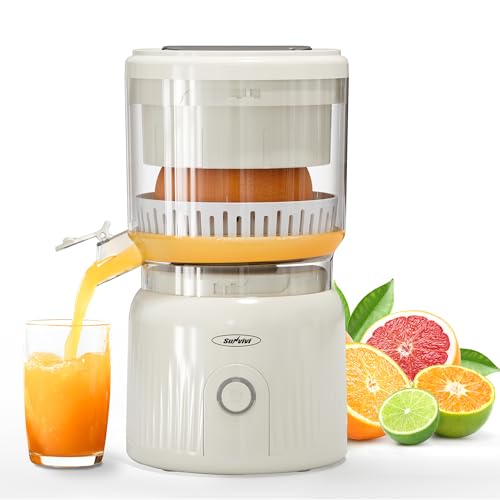
A 90-watt citrus reamer that is the cheapest of the five, the lightest at 2.53 lb, and the smallest at 4.25 x 5.12 x 10 in.
Best for: citrus-only households on a small counter Skip it if: you plan to juice kale, ginger or carrots
The SUNVIVIPRO is the cheapest pick here and the only one that publishes a wattage under 100. The 90-watt copper motor drives a 15,000 RPM reamer, which is normal for a citrus juicer and not comparable to the 43 or 80 RPM auger speeds on the masticating picks. SUNVIVIPRO describes a lid that activates the motor, a removable filter, and dishwasher-safe components. Those are the manufacturer's claims for the cleaning workflow, and the design is the same press-to-run reamer format the SMEG uses.
At 2.53 lb and a footprint of 4.25 x 5.12 x 10 in, it is by a clear margin the smallest and lightest juicer in this set. If your juicing is a glass of orange or grapefruit in the morning, and nothing more ambitious, this is the machine that draws the least wattage and takes the least counter. It is the best energy efficient juicer of the five for that narrow job.
The trade-off is the job itself. A citrus reamer will not take an apple, a carrot, a piece of celery, or a handful of kale. No warranty is published, and the sales position sits behind the SMEG among citrus picks in this set.
Pros:
- 90-watt motor, lowest published draw here
- Cheapest of the five picks
- 2.53 lb weight, lightest in the set
- Dishwasher-safe removable filter, per the listing
- 4.25 x 5.12 x 10 in footprint fits any counter
Cons:
- Citrus only, will not juice hard produce
- No warranty stated on the listing
- Sells slower than the SMEG within citrus juicers here
4. Omega VRT350 Vertical Low Speed Juicer — Best compact
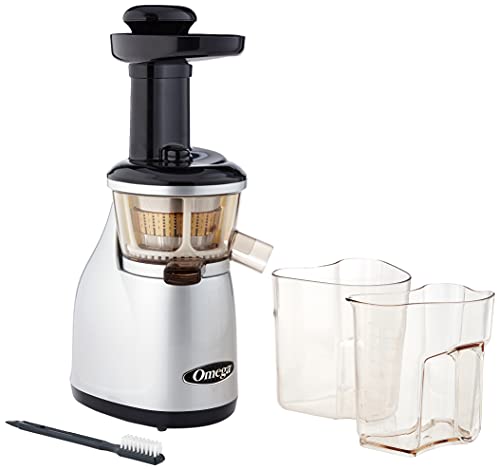
A 150-watt vertical masticator at 80 RPM with a 10-year warranty, for buyers who want the Omega build in a footprint tighter than a wide-chute machine.
Best for: single-glass mornings on a 9.49-inch-wide slice of counter Skip it if: you need a wide chute for whole fruit
The VRT350 is the second Omega in this set and it clarifies where the extra money on the VSJ843QS goes. Both draw 150 watts, both are vertical masticators, but the VRT350 runs at 80 RPM instead of 43 and carries a 10-year warranty rather than 15. Omega describes the same two-stage extraction, crush then press, and lists a three-position switch with a reverse setting for clogs. The listing says the low-speed system limits froth and oxidation and that juice can be stored up to 72 hours without separation, both manufacturer claims for the format rather than measured yield.
At 18 lb this is the heaviest pick in the set, which reads oddly for a "compact" award. The label refers to the vertical footprint, not the mass: vertical Omegas take less counter than horizontal augers, and the VRT350's footprint is smaller than the 17.6-inch EanOruus. It sells faster than the VSJ843QS within this set, which is worth noting for a machine that is nearly as expensive.
The real trade-off is efficiency headroom. At 80 RPM against the VSJ843QS's 43, and with a 10-year warranty against 15, it gives up ground to its own successor without dropping the price much.
Pros:
- 150-watt motor, tied for lowest in the set
- 10-year warranty, second longest here
- Vertical footprint saves counter width
- Reverse setting for unclogging tough greens
- Two-stage crush-then-press auger design
Cons:
- 80 RPM auger is faster than the VSJ843QS
- 18 lb, heaviest juicer in this set
- Priced near the VSJ843QS for less on the spec sheet
5. SMEG 50's Retro Style Citrus Juicer — Best for families
A press-to-start reamer with an automatic sensor, in an 11 x 8 x 7 in navy body, aimed at kitchens where kids make the orange juice.

Best for: orange-juice mornings with kids and a press-to-start reamer Skip it if: you juice hard produce like carrots or beets
The SMEG is the one buyers choose most often in this set of five, and the reason is not efficiency but ergonomics. SMEG describes a motor with a built-in sensor that activates when pressure is applied to the reamer, so there is no switch to hit. The drip-free spout and the reamer format mean a child can make a glass of orange juice with no adult on hand for the switch. The published dimensions are 11 x 8 x 7 in, which fits under most upper cabinets.
The efficiency picture is thinner. No wattage is published on the listing, and no warranty is stated. Because it is a citrus reamer, it does the same narrow job as the SUNVIVIPRO, without the 90-watt figure that pick gives you. What you are buying is the SMEG cabinet finish, the navy colour, and the press-to-start convenience, at a mid-range price position for this set.
If your household drinks a glass of orange juice a day, this is the frictionless pick. If you want a juicer that handles anything harder, look up the list.
Pros:
- Press-to-start reamer, no switch to operate
- Drip-free spout for pouring straight to a glass
- 11 x 8 x 7 in body fits under cabinets
- The one buyers choose most often in this set
- Retro navy finish that suits an on-counter home
Cons:
- No wattage published on the listing
- No warranty stated on the listing
- Citrus only, will not juice hard produce
Masticating or citrus: which suits your produce?
The first fork in choosing the best energy efficient juicer is not brand and not wattage, it is what goes in the chute. A masticating auger and a citrus reamer solve different problems.
- Choose a masticating juicer if you juice leafy greens, celery, carrots, ginger, apples or beets. The Omega VSJ843QS, Omega VRT350 and EanOruus are the three picks here that handle hard and fibrous produce.
- Choose a citrus reamer if your juicing begins and ends with oranges, lemons and grapefruit. The SUNVIVIPRO and the SMEG are the two picks here built for exactly that.
Buying the wrong side of that fork is the most common way people waste money in this category. A masticating juicer will process citrus, but you will peel every orange first and clean an auger afterwards. A citrus reamer will not process a carrot at all, and no wattage figure changes that.
The cutoff is simple: if more than a quarter of your juice comes from something other than citrus, buy a masticator. If it does not, buy a reamer and save the counter space.
How much does a slow juicer actually save on a glass?
Efficiency in a juicer is a two-part number: the electricity the motor draws while it runs, and the juice you extract from the produce. The second half is bigger than the first.
A 150-watt masticator like the VSJ843QS running for four minutes uses roughly the same electricity as a bright kitchen light for the same time. A 400-watt cold press running for the same job uses more, but if it extracts a fifth more juice from the same bag of carrots, you buy fewer carrots. Produce cost is the dominant line on the household budget for anyone juicing daily. Motor wattage is a rounding error next to it.
Which is why the specification that decides efficiency is not the watt sticker but the auger. A slow squeeze at 43 RPM against a fast crush at 80 RPM against a wide-chute press at 50 RPM behaves differently on kale and celery, and the difference shows up as pulp in the bin. The best energy efficient juicer is the one that leaves the driest pulp for the produce you actually buy.
What the listings will not tell you about efficiency
Three things the product pages do not spell out, that decide whether the machine is efficient in your kitchen:
- Continuous run time. None of the five listings specifies how long the motor can run without a rest. For batch juicers this matters more than wattage. A machine that has to cool for ten minutes between quarts is not efficient at any wattage.
- Cleaning time per session. The VSJ843QS lists an auto-cleaning system for the screen, the EanOruus lists three detachable parts and a brush, the SUNVIVIPRO lists a dishwasher-safe filter. Cleaning is where the "quick glass of juice" plan dies. A ten-minute wash after a two-minute juice is a bad efficiency ratio.
- Pulp dryness. No listing here publishes a yield percentage or a pulp-moisture number. The manufacturer sentences on yield are claims, not measurements, and the only way to tell in your kitchen is to weigh the pulp.
If a listing does not disclose these, you are guessing on the numbers that matter. Assume the machine has to earn them, and pick the one whose published specifications leave the least to fill in.
The verdict
The best energy efficient juicer for daily use across a range of produce is the Omega VSJ843QS. It is 150 watts, the lowest in this set, at 43 RPM, the slowest auger here, backed by a 15-year motor warranty, the longest on any pick reviewed. That combination, low wattage, slow squeeze, long warranty, is the shape you want in a machine that will run four to six times a week for years.
If your juicing is a whole apple or a stalk of celery, not a bag of kale, the EanOruus wins. A 5.8-inch chute cuts prep time to nothing and its reverse mechanism prevents the mid-session stalls that make cold-press juicing frustrating. The higher 400-watt draw is a real cost, but the saved chopping recovers it, and the price position is friendly.
If you only juice citrus, the cutoff is small counters against a bigger family. Under 3 lb and less than 5.5 inches wide, the SUNVIVIPRO at 90 watts is enough. If two or three people share a morning glass and the juicer stays out on the counter, the SMEG press-to-start reamer is the friendlier tool, at the cost of a wattage figure you cannot see.
FAQ
Is a masticating juicer more energy efficient than a centrifugal one?
A masticating juicer generally draws less wattage than a centrifugal one, and both Omega picks in this set list 150 watts against a 400-watt cold-press cousin. But watts alone do not decide efficiency. A slow auger like the VSJ843QS at 43 RPM extracts more juice from the same produce, which cuts your grocery cost, and that saving dwarfs the electricity difference on any home meter.
Is the Omega VSJ843QS worth the extra money over the VRT350?
The VSJ843QS is worth the step up if you juice daily and want the longest warranty. Both draw 150 watts, but the VSJ843QS runs at 43 RPM against the VRT350's 80 RPM, and its motor warranty is 15 years against 10. For weekly-only juicing the older VRT350 saves you money and gives up little. For daily use, the newer model is the better long-run buy.
How does the EanOruus compare to the Omega VSJ843QS on real energy use?
The EanOruus draws 400 watts against the Omega VSJ843QS's 150 watts, so per minute of running time it uses more electricity. But its 5.8-inch chute takes whole apples and carrots, so the motor runs briefly. If you finish a session in two minutes on the EanOruus and eight minutes on the Omega, the wattage gap narrows and prep time favours the wider chute.
What wattage counts as low for a juicer?
Low wattage for a juicer sits around 150 watts on a masticating auger and under 100 watts on a citrus reamer. The Omega VSJ843QS and VRT350 both publish 150 watts, and the SUNVIVIPRO citrus juicer publishes 90 watts. Above 400 watts, you are usually looking at centrifugal designs or wide-chute cold presses, which trade higher instantaneous draw for shorter run time per glass.
Can I use a citrus juicer for apples or carrots to save energy?
Citrus juicers cannot process apples or carrots. The SUNVIVIPRO and SMEG picks here use a reamer that presses a halved citrus fruit against a rotating cone, which is the wrong tool for hard or fibrous produce. Trying it damages the reamer and wastes the fruit. If you want to juice apples, carrots, celery or greens, you need one of the three masticating juicers in this set.
Efficiency in a juicer is not a single sticker on the box, it is a combination of what the motor draws, how fast the auger turns, how wide the chute is, and how dry the pulp comes out. The Omega VSJ843QS wins the top spot here because it lines up three of those four levers in the right direction, at the cost of a premium price position and a warranty long enough to defend it. Pick the machine that matches the produce you actually buy each week, not the one with the smallest wattage number on the label, and the juicer will earn its counter space for years.