Best Transitional Sippy Cup When Spills Rule Your Day

Five bottle-to-cup picks compared on spout type, capacity and how many cups you get in the box, with the NUK First Choice Large Learner Cup 2.0 as the default and the flips that change the answer.

By Jody SargentUpdated 15 min read
On this page
- Best transitional sippy cup at a glance
- How I screened these five listings
- Soft spout or weighted straw: which transitions faster?
- 1. NUK First Choice Large Learner Cup 2.0 — Best overall
- 2. Dr. Brown's Milestones Baby's First Straw Cup — Best budget pick
- 3. NUK Active Sippy Cup — Best premium
- 4. Nuby 3 Count No-Spill Grip N' Sip Cup — Best minimal setup
- 5. Philips Avent My Easy Sippy Cup with Soft Spout — Best upgrade
- How many cups do you actually need in rotation?
- What the listings don't tell you about leak-proofing
- When a different transitional sippy cup wins
- The verdict
- FAQ
The best transitional sippy cup is the NUK First Choice Large Learner Cup 2.0, a 10 oz soft-straw cup that arrives two to a box with removable anti-slip handles. If your baby needs a weighted straw that keeps drawing liquid when the cup tips backward, Dr. Brown's Milestones Baby's First Straw Cup is the better buy at 9 oz.
Get this wrong and you don't just waste money. You lose a week. A cup your baby refuses means back to the bottle, a soaked shirt at every meal, and a second purchase you resent.
Best transitional sippy cup at a glance
| Pick | Spout type | Capacity & count | Price |
|---|---|---|---|
Best overall NUK First Choice Large Learner Cup 2.0 |
Soft straw | 10 oz 2 cups |
Check Price |
Best budget pick Dr. Brown's Milestones Baby's First Straw Cup |
Weighted silicone straw | 9 oz 1 cup |
Check Price |
Best premium NUK Active Sippy Cup |
Soft spout | 10 oz 2 cups |
Check Price |
Best minimal setup Nuby 3 Count No-Spill Grip N' Sip Cup |
Soft silicone spout | 10 oz 1 cup |
Check Price |
Best upgrade Philips Avent My Easy Sippy Cup with Soft Spout |
Soft silicone spout | 9 oz 2 cups |
Check Price |


How I screened these five listings
I started with the published specifications rather than the marketing copy, because that's the only part of a listing that stays comparable across brands. Five cups from the Solid Feeding cups category, all sitting in the same size range.
Here's what I lined up for each one:
- Capacity in ounces, so a parent can judge one refill against two.
- How many cups come in the box, because rotation is the real cost.
- Spout type: soft spout, soft straw, or weighted straw.
- Whether handles are stated as removable.
- Total weight, which decides whether a toddler can lift it full.
What got cut from consideration was anything without a stated capacity, and anything where the count wasn't published. Two cups at 10 oz each is a different purchase from one cup at 10 oz, and a listing that hides the count hides the thing you'd compare first.
None of the five publishes a warranty. That's normal for this category and it's not a mark against any single pick, but it means you're judging on specification and design intent alone.
Soft spout or weighted straw: which transitions faster?
Most transitional sippy cup guides compare capacity. That isn't what decides it. The spout is.
A soft spout asks your baby to do roughly what a bottle nipple asked: tip the cup, suck, swallow. It's the shortest jump from a bottle, which is why three of these five use one. The trade-off is that a spout is still a nipple-shaped thing, and some paediatric guidance pushes families toward straws sooner rather than later.
A straw asks for a new skill. Your baby has to draw liquid up instead of tipping it down. Harder at first. But a straw cup is closer to an open cup, and it doesn't need to be tipped, which matters when a toddler is strapped into a car seat.
Then there's the weighted straw. Dr. Brown's puts a soft silicone weight on the straw so it follows the liquid as the cup moves. The listing says baby can tip and sip in any direction. That's the design solving the exact failure mode of an unweighted straw: liquid pools at the back, the straw sits in air, the baby gives up.
- Coming straight off a bottle at 8 months? Start with a soft spout.
- Already sipping from your straw at a restaurant? Go straight to a straw cup.
- Baby tips the cup back like a bottle? A weighted straw fixes that behaviour instead of fighting it.
1. NUK First Choice Large Learner Cup 2.0 — Best overall
A 10 oz soft-straw cup that comes two to a box with handles you can pull off later, which covers more of the transition than anything else here.
Best for: an 8-month-old moving off the bottle with a parent who wants two cups in rotation Skip it if: you want straw drinking from day one
This is the only pick in the set that pairs a soft straw with a two-cup count. That combination is why it leads. You get the straw skill your baby will need for an open cup, and you get a spare so one can sit in the dishwasher while the other is on the highchair tray.
Capacity is 10 oz, matching the largest cups here. The whole two-pack weighs 5.92 oz, so an individual cup is genuinely light for small arms. The handles are easy-grip and anti-slip according to NUK, and the listing states they're removable as baby grows, which means the cup survives past the stage where handles help. NUK also lists it as spill and leak proof, and describes the spout as soft and gentle on teeth and gums. Those are the manufacturer's claims, not a measured figure.
Age guidance on the listing is 8 months and up, which is later than some of the others. It's BPA-free and dishwasher-safe.
The trade-off: this sits in the more expensive half of the set, and only one seller lists it. It also asks your baby to learn straw drinking straight away, which is a steeper first week than a soft spout.
Pros:
- 10 oz, tied for largest capacity here
- Two cups per box for rotation
- Handles stated as removable as baby grows
- Soft straw, the closest step to an open cup
- BPA-free and dishwasher-safe
Cons:
- Straw drinking is a harder first skill than a spout
- Priced in the upper half of this set
- Only one seller lists it
- Age guidance starts at 8 months, later than two rivals
2. Dr. Brown's Milestones Baby's First Straw Cup — Best budget pick
The weighted straw solves the one problem that makes babies quit on straw cups, and it's the cheapest pick of the five.

Best for: babies who tip the cup back like a bottle and need the straw to follow Skip it if: you need more than one cup in the box
This is the cheapest of the five and it's also the one buyers choose most often here, which is an unusual pairing. The reason is the straw.
Dr. Brown's describes a soft silicone weighted straw that moves with the liquid so baby can tip and sip in any direction. Babies coming off a bottle tip the cup back on instinct. With a fixed straw that ends the drink. With a weighted one, the intake follows the liquid to the back of the cup and the sip keeps working. It's the single smartest bit of design in this roundup.
Capacity is 9 oz. Weight is 4.66 oz, the second-lightest here. The handles are side-grip and stated as removable, and the cup body is contoured. The lid slides over the straw for travel, which the listing frames as both spill-proof and hygienic storage, so the straw isn't collecting lint in a diaper bag. Measuring marks on the side let you see intake, useful if you're tracking fluid volume during weaning.
The cost of the low price is count. One cup, not two. If you want a spare, you're buying twice, which erases the saving.
Pros:
- Cheapest of the five picks
- Weighted silicone straw follows the liquid in any position
- 4.66 oz, second-lightest cup here
- Sliding lid covers the straw for travel
- Measuring marks show how much baby drank
Cons:
- One cup per box, no spare in rotation
- 9 oz, smaller than the two 10 oz picks
- More parts to wash than a one-piece valve cup
- Only one seller lists it
3. NUK Active Sippy Cup — Best premium
Two 10 oz soft-spout cups with a carrying clip, built for bags and strollers rather than the kitchen table.

Best for: diaper bags, strollers and car seats where a clip earns its keep Skip it if: character prints aren't your thing
This is the most expensive pick here, and the feature you're paying for is portability. NUK lists a carrying clip and describes the cup as ultra-lightweight. The stated weight is 5.71 oz for the two-pack, so it's marginally lighter than the First Choice pair despite matching its 10 oz capacity.
The spout is soft and described as spill-proof and gentle on gums. That's a gentler starting point than a straw for a baby who has only ever used a bottle. NUK also notes it's compatible with their Learner Straw Cups, which is the quiet argument for this pick: buy the spout version now, swap to a straw top later, keep the same cup bodies. That's a real upgrade path rather than a second purchase.
It's a 2025 listing, the newest here, in a Disney Cars print with Lightning McQueen. Two cups per box, BPA-free, dishwasher-safe, 8 months and up.
The trade-off is stark. You pay the most in this set for a soft spout, while the cheapest pick gives you a weighted straw. You're buying the clip, the print and the straw-top compatibility, not more drinking capability.
Pros:
- 10 oz, tied for largest here
- Two cups per box
- 5.71 oz, lightest two-pack in the set
- Carrying clip for strollers and bags
- Stated compatibility with NUK Learner Straw Cups
Cons:
- The most expensive pick in this set
- Soft spout only, no straw included
- Character print won't suit every household
- Only one seller lists it
4. Nuby 3 Count No-Spill Grip N' Sip Cup — Best minimal setup
At 2.5 oz it's the lightest cup here by a wide margin, and it starts at 4 months rather than 8.

Best for: a light, simple cup for a baby starting sips around 4 months Skip it if: you want two matching cups from one purchase
Weight is the headline. 2.5 oz, which is less than half what the two-pack picks weigh and lighter than every single-cup rival here. For a baby who is still working out how to lift anything, that difference is the whole experience.
Nuby says the cup holds up to 10 ounces of water, milk or juice and is suited to kids 4 months and up, the earliest starting age in this roundup. The soft silicone spout is described as gentle on gums and teeth, and Nuby's TOUCH-FLO valve is claimed to open only when your child sips. The Clik-It lid, per the listing, gives an audible confirmation that it's seated, which is the sort of small thing you appreciate at 6am. Handles and a contoured base round it out, and it's listed as top-rack dishwasher safe.
Read the count carefully. The title says 3 Count, but the published count on this listing is 1 and the stated colour covers blue, gray and aqua. Two sellers stock it, which is more than any other pick here.
The trade-off: the lightest, simplest cup in the set is also the one where you can't be certain how many arrive, and it offers a spout rather than a straw.
Pros:
- 2.5 oz, lightest cup in this comparison
- 10 oz capacity, tied for largest
- Stated suitable from 4 months, earliest here
- Clik-It lid confirms the seal audibly
- Two sellers stock it, more than the rest
Cons:
- Listing count reads 1 despite a 3 Count title
- Soft spout only, no straw option
- No stated warranty
- Handles are not described as removable
5. Philips Avent My Easy Sippy Cup with Soft Spout — Best upgrade
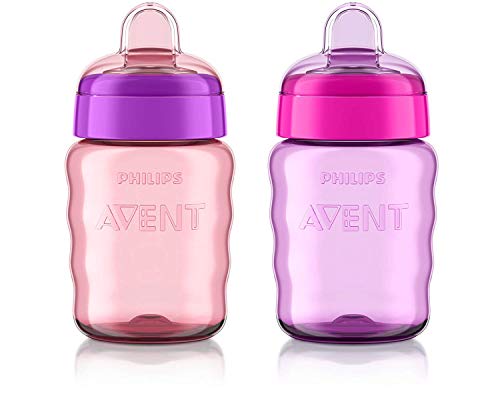
A one-piece built-in valve means the fewest parts to lose, wash and reassemble of anything here.
Best for: parents who want the fewest parts to wash and reassemble Skip it if: you want the lightest cup for a diaper bag
Every sippy cup fails the same way: a valve goes missing, or it gets put back inside out. Philips Avent's answer is a one-piece built-in valve that the listing credits with preventing spills. Fewer parts, fewer chances to get it wrong at the sink. The listing states all parts are dishwasher safe.
Capacity is 9 oz, and you get two cups. The spout is flexible soft silicone, described as gentle on gums. Instead of handles, the body carries a rippled anti-slip texture that Philips Avent says is easy for little hands to hold. That's a design choice with a consequence: no handles to remove later, but also no handles to help a baby who still needs them. It's the second-cheapest pick here, which makes the two-cup count good value.
Dimensions are 3.54 x 5.12 x 5.12 in and the model is SCF553/23, a 2015 listing. That's the oldest design in this set. Stated weight is 8 oz for the pair, the heaviest here.
The trade-off: you gain simplicity and lose grip options. A baby who can't yet manage a smooth-sided cup will do better with the handled picks.
Pros:
- One-piece built-in valve, fewest parts to reassemble
- Two cups per box
- Second-cheapest pick in this set
- Rippled anti-slip texture instead of loose handles
- All parts stated dishwasher safe
Cons:
- No handles at all, so no help for weaker grips
- 8 oz for the pair, heaviest here
- 9 oz capacity, below the 10 oz picks
- 2015 design, the oldest in this roundup
How many cups do you actually need in rotation?
Two. That's the honest answer, and it's why count matters as much as capacity when you're choosing a transitional sippy cup.
A cup in daily use gets washed after every drink. One cup means you're washing on demand, mid-meal, with a shouting baby. Two means one goes in the dishwasher and the other keeps working.
Three of these five give you two cups from one purchase: both NUK picks and the Philips Avent. Dr. Brown's and the Nuby list a count of 1. If you buy either of those and then buy a second, you've spent more than a two-pack cost.
The exception is deliberate variety. If you're not sure whether your baby will take a spout or a straw, buying one of each beats buying two of the wrong one.
What the listings don't tell you about leak-proofing
Every pick here uses some version of the phrase spill-proof or no-spill. NUK says spill and leak proof. Philips Avent credits its one-piece valve. Nuby names a TOUCH-FLO valve that opens only on a sip. Dr. Brown's ties spill-proofing to its sliding lid.
None of that is a standardised measurement. There's no published drop-test figure, no pressure rating, nothing you could compare down a column. Take these as design intent, not a guarantee.
What you can compare is mechanism, and mechanism predicts behaviour:
- Valve-based cups (Nuby, Philips Avent) hold liquid until suction opens the valve. A dropped cup usually holds. A valve installed backward leaks immediately.
- Sliding-lid cups (Dr. Brown's) close over the straw for transport. Sealed in a bag, open at the table.
- Straw cups without a cover will drip from the straw when packed.
The practical rule for the best transitional sippy cup: a cup with a valve is drop-resistant, and a cup with a lid is bag-resistant. Those are different problems. Match the one you actually have.
When a different transitional sippy cup wins
The NUK First Choice is the default, not the universal answer. Here's when it isn't.
If your baby tips the cup back like a bottle, switch to Dr. Brown's. The weighted straw keeps drawing from whatever corner the liquid has moved to. A fixed straw in a tipped cup pulls air, and a baby who gets air twice stops trying.
If most drinking happens out of the house, the NUK Active earns its price. A clip on a stroller frame, 5.71 oz for the pair, and the option of swapping to a NUK straw top on the same bodies later.
If your baby is closer to 4 months than 8, the Nuby is the only pick with a stated age that low, at 2.5 oz. The others in this set start at 8 months.
If your dishwasher rack is the bottleneck, the Philips Avent's one-piece valve means fewer small parts to place, find and reassemble.
The verdict
The NUK First Choice Large Learner Cup 2.0 is the best transitional sippy cup for most families because it does the job you'll still need done in three months. A soft straw, 10 oz of capacity, two cups so one is always clean, and handles that come off when your baby stops needing them. Nothing else here covers that much of the transition in one purchase.
Two conditions flip it. First, if your baby drinks lying back or tipping the cup like a bottle, buy Dr. Brown's Milestones Baby's First Straw Cup instead. Its weighted silicone straw follows the liquid, and that one feature decides whether a baby persists or quits. It's also the cheapest pick here, so the experiment costs little.
Second, if the cup lives in a diaper bag, the NUK Active Sippy Cup takes it. The carrying clip and the 5.71 oz two-pack weight matter more on a stroller than they ever will on a highchair tray, and NUK states these cup bodies accept their Learner Straw Cup tops later.
The runner-up's exact advantage over the winner is the weight on the straw. Not price, not capacity. That weight is what keeps a sip working when the cup isn't upright.
FAQ
Is a transitional sippy cup worth buying at all?
A transitional sippy cup is worth buying if your baby is still on a bottle and can't manage an open cup without soaking the floor. It gives them a controlled way to practise suction and grip. If your baby already drinks from a straw you hold, skip the middle step and go to a straw cup directly.
What is the best transitional sippy cup for a baby coming straight off a bottle?
For a baby coming straight off a bottle, a soft spout is the gentler start because the action is closest to a nipple. The NUK Active Sippy Cup and the Philips Avent My Easy Sippy Cup both use soft silicone spouts. Move to a straw once your baby is drinking confidently, since a straw is the closer relative of an open cup.
Which capacity should I choose, 9 oz or 10 oz?
Choosing between 9 oz and 10 oz matters less than you'd think, because babies at this stage rarely finish either in one sitting. The NUK picks and the Nuby hold 10 oz. Dr. Brown's and the Philips Avent hold 9 oz. Pick on spout type and count first, then take whichever capacity comes with it.
NUK First Choice or Dr. Brown's Milestones: which straw cup should I buy?
Between NUK First Choice and Dr. Brown's Milestones, the split is count against straw design. NUK gives you two 10 oz cups so one is always clean. Dr. Brown's gives you one 9 oz cup with a weighted silicone straw that follows the liquid at any angle. Buy Dr. Brown's if your baby tips the cup; buy NUK for the rotation.
What mistake do parents make with a transitional sippy cup?
The mistake parents make with a transitional sippy cup is buying one cup and expecting it to keep pace with meals. A single cup needs washing between every drink, which means hand-washing mid-meal. Buy a two-pack, or accept that you'll be at the sink. The other common error is filling a 10 oz cup to the top for a first attempt.
Start with the NUK First Choice Large Learner Cup 2.0, fill one cup a third full, and offer it at a meal where your baby is thirsty but not desperate. Two cups in the box means the first refusal costs you nothing but a rinse. If the straw doesn't land after a few days, the weighted straw on Dr. Brown's is the cheapest correction available, and it fixes the specific reason most babies abandon a straw cup. The transition isn't one purchase. It's a spout, then a straw, then an open cup, and the winner here is the pick that already sits on the second rung.