Best Small Stand Mixer for Beginners: OLIXIS Wins
A first stand mixer should feel forgiving, not intimidating. Six compact picks ranked by capacity, speed range, and how easily they fit a small kitchen.

By Jody SargentUpdated 16 min read
On this page
- Best small stand mixer for beginners at a glance
- How I narrowed the field to these six
- 1. OLIXIS 6.3 Qt Stand Mixer — Best overall
- 2. Kitchen in the box Stand Mixer — Runner-up
- 3. Vikaluz 3.2QT 2-in-1 Stand Mixer — Best for beginners
- 4. NEWBULIG Stand Mixer 6.3QT — Best for heavy use
- 5. Hamilton Beach Classic Stand and Hand Mixer — Best budget pick
- 6. Martha Stewart 5.3QT Tilt Head Stand Mixer — Best premium
- What size bowl does a beginner actually need?
- Speeds, motors and the specs that mislead first-time buyers
- Will it fit under a standard kitchen cabinet?
- What the listings do not tell you about beginner-friendly features
- The verdict
- FAQ
The best small stand mixer for beginners is the OLIXIS 6.3 Qt Stand Mixer, a 7.1 lb tilt-head with a 300W motor and 10 speeds that keeps first-time bakers in easy territory without capping their recipes at a single loaf. If your counter is truly tight, the Kitchen in the box 3.2QT is the smarter buy at 10.2 x 12.9 x 7 in and the same 7 lb weight. Below, six picks ranked by what actually helps a beginner: bowl size, speed range, and footprint.
Best small stand mixer for beginners at a glance
| Pick | Bowl | Speeds | Price |
|---|---|---|---|
Best overall OLIXIS 6.3 Qt Stand Mixer |
6.3 qt | 10 | Check Price |
Runner-up Kitchen in the box Stand Mixer |
3.2 qt | 6 | Check Price |
Best for beginners Vikaluz 3.2QT 2-in-1 Stand Mixer |
3.2 qt | 5 plus turbo | Check Price |
Best for heavy use NEWBULIG Stand Mixer 6.3QT |
6.3 qt | 10 | Check Price |
Best budget pick Hamilton Beach Classic Stand and Hand Mixer |
4 qt | 6 | Check Price |
Best premium Martha Stewart 5.3QT Tilt Head Stand Mixer |
5.3 qt | 12 | Check Price |



How I narrowed the field to these six
I started with the small-and-mid-size tilt-head category and screened for three things a beginner actually cares about: a bowl under 7 quarts so the machine still fits a normal counter, at least five speed settings so slow folding is possible, and a full set of the three standard attachments so nothing extra needs buying on day one.
Two disqualifications did most of the work. Anything without a wire whisk, dough hook and flat beater in the box was cut, because a first-time baker should not have to hunt for a paddle before making cookies. So was anything that only listed a peak-watt figure without a matching speed count, since a strong motor with two speeds is worse for a beginner than a modest motor with ten.
That left six survivors spanning three sizes. A 3.2-quart tier for tight kitchens: the Kitchen in the box and the Vikaluz. A 4 to 5.3-quart middle: Hamilton Beach and Martha Stewart. And two 6.3-quart machines from OLIXIS and NEWBULIG that share dimensions of 12.3 x 13.9 x 7.6 in and a weight of 7.1 lb, suggesting the same underlying build.
Note on the beginner label in the search: only one of these six carries the word "beginners" in its listing, so treat that qualifier as a hint from Amazon, not a filter. The picks below are chosen for what makes a first stand mixer easy to live with.
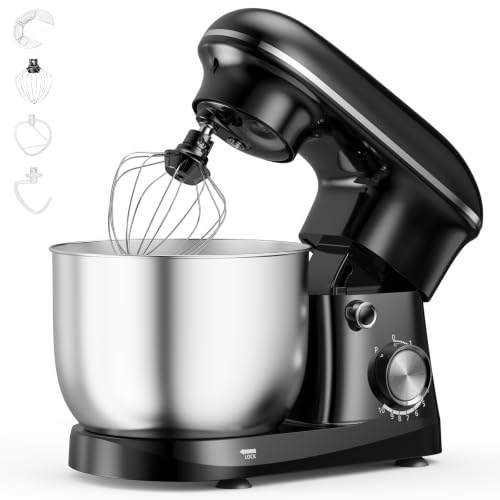
1. OLIXIS 6.3 Qt Stand Mixer — Best overall
The OLIXIS is the best small stand mixer for beginners because it pairs a beginner-friendly 10 speeds with enough bowl capacity to grow into.
Best for: a first-time baker who wants room to grow into bigger recipes Skip it if: your counter space is truly tight or you rarely bake for more than two
Two things push the OLIXIS ahead of the smaller picks. First, the 6.3-quart bowl handles a double batch of cookies without you halving recipes on day one, which is how most beginners actually learn: by following a recipe as written. Second, ten speeds beats the five or six on the smaller machines, and the extra low-end steps are where a nervous baker most needs the control. OLIXIS says the 300W motor covers stiff pizza dough through runny cake batter.
The footprint stays reasonable at 12.3 x 13.9 x 7.6 in, and at 7.1 lb it lifts down from a shelf without a struggle. The listing also mentions a 4.2-quart version and a blue exterior, useful if the 6.3-quart bowl feels like overkill. Every core attachment ships in the box: dough hook, wire whisk, flat beater.
The trade-off is honest. This is the second-cheapest of the six, sells faster than most of the set, and the brand is not a household name. If that matters to you, look at the Hamilton Beach or Martha Stewart picks below.
Pros:
- 10 speeds, more than any pick under 5 quarts here
- 6.3 qt bowl handles double batches
- 300W motor claim for both dough and batter
- All three standard attachments included
- 12.3 x 13.9 x 7.6 in footprint fits most counters
Cons:
- Brand less familiar than Hamilton Beach or Martha Stewart
- No published warranty in the listing
- 6.3 qt is more bowl than a one-person kitchen needs
2. Kitchen in the box Stand Mixer — Runner-up
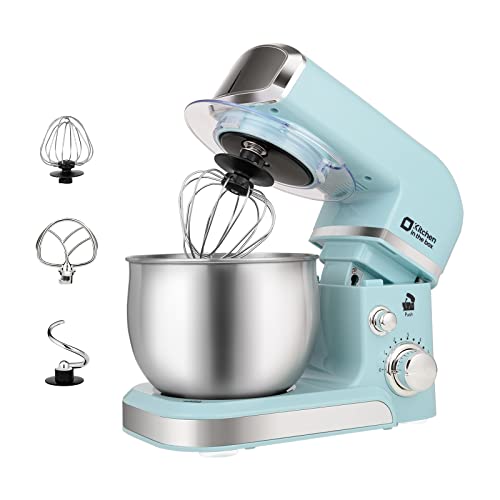
The Kitchen in the box is the pick when the deciding factor is counter space, not capacity.
Best for: couples and 1-2 person households in small kitchens Skip it if: you plan to double cookie batches or knead two loaves at once
At 10.2 x 12.9 x 7 in and 7 lb, this is the smallest machine in the set on every axis. The 3.2-quart stainless bowl is the same size as the Vikaluz below, but the Kitchen in the box sits at a lower price position and has one more speed (six versus five plus turbo). The listing describes the 3.2-quart bowl as suitable for a new baker or a 1-2 person household, which is a fair summary of what this tier of mixer is for.
Six speeds is the practical minimum for a beginner: a slow fold speed to start the flour, a medium for creaming butter, a high for whipping. This has all three. Four anti-slip suckers on the base help with the wobble that plagues light mixers on smooth counters, and the aluminium dough hook, flat beater and stainless whisk cover the basics.
Set against the OLIXIS, the loss is real: half the bowl, four fewer speeds, no larger size to trade up to. Against the Vikaluz, you gain a speed and lose the auto-rotating bowl. This one is bought for footprint, and it earns that pick.
Pros:
- Smallest footprint here at 10.2 x 12.9 x 7 in
- 7 lb weight is easy to lift and store
- Six speeds cover every common beginner task
- Four suction feet resist wobble
- Three attachments included
Cons:
- 3.2 qt caps recipe size early
- No warranty stated in the listing
- Aluminium hook rather than stainless
3. Vikaluz 3.2QT 2-in-1 Stand Mixer — Best for beginners
The Vikaluz is the only pick here that doubles as a detachable hand mixer, which flattens the learning curve for small jobs.

Best for: someone who wants a hand mixer and stand mixer in one machine Skip it if: you want the lowest price or the biggest bowl
Two features earn Vikaluz its label. The head detaches into a hand mixer, so whipping a small bowl of cream or beating two eggs does not mean hauling out the whole machine. And the bowl auto-rotates 360 degrees while a dual-direction beater turns the other way, which the manufacturer says removes the need to scrape the sides mid-mix. For a beginner who has never used a stand mixer, that hands-free behaviour is one less thing to learn.
Five speeds plus a turbo boost is the shortest speed list in this shortlist, but the range spans folding to peak whipping. The 3.2-quart capacity, per the listing, fits two loaves of bread or three dozen cookies. Dimensions of 13.7 x 7.88 x 12.4 in slide under most cabinets, and this is the newest release in the set, dated 2025.
The trade-offs: this is the second-most-expensive pick here and sells the slowest of the six. You are paying for the 2-in-1 mechanism and the rotating bowl, not for a bigger bowl or a longer track record.
Pros:
- Detaches into a hand mixer, unique in this set
- Auto-rotating bowl claim reduces scraping
- 2025 model with newest listing
- Turbo boost adds a fast top gear
- Dough hook, flat beater, whisk all included
Cons:
- Only five speeds, the fewest in the set
- Highest price position after the Martha Stewart
- No weight listed in the specifications
4. NEWBULIG Stand Mixer 6.3QT — Best for heavy use
The NEWBULIG matches the OLIXIS spec for spec, so pick it if the blue colour or a different seller suits you better.

Best for: weekend bakers who make bread and cookies regularly Skip it if: you prefer a household name brand with a stated warranty
The specifications here mirror the OLIXIS almost line for line: 6.3-quart bowl, 300W motor claim, 10 speeds, 7.1 lb, and identical dimensions of 12.3 x 13.9 x 7.6 in. Both listings describe the same all-in-one lid with six accessory features (magnifier, slicer, egg separator, measuring cup, scale, serrated edge), and both ship with the standard three attachments plus a bowl cover. NEWBULIG's listing puts extra weight on the suction base and its resistance to vibration, which is a genuine beginner concern with a light mixer moving stiff dough.
Where they differ is price position and popularity. NEWBULIG sits one price step higher and sells more slowly than the OLIXIS, so most shoppers picking between the two will land on the OLIXIS by default. NEWBULIG earns the "heavy use" label because it foregrounds stability rather than bells and whistles: the sturdy base, the food-safe materials, the same 300W motor doing the same job.
The trade-off against OLIXIS is small and real: a higher price position for what looks like the same machine in a different colour.
Pros:
- 6.3 qt bowl handles bread and double cookie batches
- 10 speeds match the top of the set
- Same dimensions and weight as the OLIXIS
- Suction base emphasised for stability
- Six-tool lid cover included
Cons:
- Priced above the near-identical OLIXIS
- No warranty stated in the listing
- Slower seller than the OLIXIS
5. Hamilton Beach Classic Stand and Hand Mixer — Best budget pick
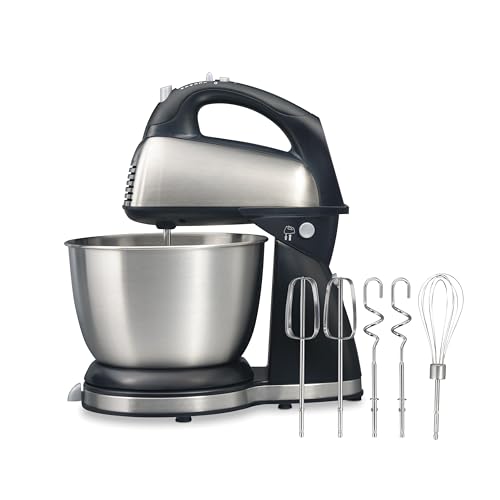
The Hamilton Beach is the pick for a nervous first buyer: familiar brand, published warranty, and a hand mixer built in.
Best for: a nervous first buyer who wants a known brand and a warranty Skip it if: you want more than six speeds or a bowl bigger than 4 quarts
This is the cheapest of the six and the only pick with a one-year warranty in the specifications. The 4-quart stainless bowl sits between the 3.2-quart compacts and the 6.3-quart pair, which is a fair sweet spot for a beginner unsure how often they will bake. The listing describes 290 watts of peak power, six speeds with a QuickBurst button, and a Shift and Stir lever that moves the bowl side to side while it mixes.
Attachment count is the highest in the set: five pieces, including two beaters, two dough hooks and a whisk. The head detaches into a hand mixer, matching the Vikaluz trick, and Hamilton Beach as a brand needs no introduction. Dimensions are 14.3 x 13.3 x 8.2 in, so it takes a bit more depth than the 3.2-quart machines but stays under most cabinets.
The honest trade-off: six speeds is fewer than any 6.3-quart pick here, and the 290W peak rating means the sustained power under thick dough will not match the 300W-claim machines. For a beginner starting with cookies and cakes, that ceiling rarely gets hit.
Pros:
- Cheapest of the six
- Only pick with a one-year warranty in the listing
- Detaches into a hand mixer
- Five attachments, most in the set
- Household brand recognition
Cons:
- Six speeds ties for fewest, tied with the 3.2QT pick
- 290W is a peak-only figure
- Sells more slowly than the OLIXIS, Kitchen in the box or NEWBULIG
6. Martha Stewart 5.3QT Tilt Head Stand Mixer — Best premium
The Martha Stewart is the pick if you plan to keep this mixer for years, not months.

Best for: beginners planning to bake often and keep the mixer for years Skip it if: your counter is under 17 inches deep or storage is tight
Twelve speeds is the most in this set, and the extra granularity between "gentle fold" and "whip" is where a beginner most benefits from precision. The 5.3-quart bowl sits between the compact 3.2-quart tier and the 6.3-quart pair, which the listing pairs with a claim of up to 9 dozen cookies per batch. A silicone edge on the flat beater and a removable splash shield are two touches missing from every cheaper pick in this shortlist.
This is also the heaviest and largest machine here at 9.04 lb and 16.9 x 16.9 x 10.4 in, which changes the storage question entirely: it will not slide out of the way like the 3.2-quart picks do. The linen cream finish is aimed squarely at a mixer that lives on the counter rather than in a cupboard.
The premium price position is the highest of the six, and no warranty is stated in the listing. What you get in return is more speeds, more considered accessories, and a brand a first-time baker will recognise from cookbooks and magazines.
Pros:
- 12 speeds, most in this shortlist
- Silicone-edged flat beater
- Removable splash shield with pour chute
- Brand a beginner will already know
- 5.3 qt handles large batches
Cons:
- Most expensive pick here
- Heaviest at 9.04 lb
- 16.9 x 16.9 x 10.4 in needs real counter space
What size bowl does a beginner actually need?
The reflex is to buy small, on the theory that a beginner makes small things. The data in this set argues the opposite for most kitchens.
A 3.2-quart bowl, like the Kitchen in the box or the Vikaluz, is sized for a 1-2 person household in the manufacturers' own words. That is fine for whipping cream, beating eggs, or mixing a single loaf. It is uncomfortable for a standard cookie recipe scaled up to feed guests, and it caps you at half of many cake batters. If you plan to follow recipes as written, 3.2 quarts is a constraint you will feel by the third weekend.
A 4-quart bowl, on the Hamilton Beach, is the pragmatic middle. It handles most single-batch recipes without leaving you with a permanent smaller-than-normal mixer.
A 5.3 or 6.3-quart bowl, on the Martha Stewart, OLIXIS or NEWBULIG, is where you stop halving recipes. The trade-off is footprint: 16.9 x 16.9 x 10.4 in on the Martha Stewart is a permanent counter resident.
The trick for a beginner: buy the bowl size that matches the recipes you already read, not the ones you think you might grow into.
Speeds, motors and the specs that mislead first-time buyers
The specification that gets quoted most is wattage. It is also the least useful one for a beginner, because peak watts (as on the Hamilton Beach's 290W) and stated motor watts (the 300W claim on the OLIXIS and NEWBULIG) are not the same measurement, and neither tells you how the machine feels folding flour.
The specification that actually helps a first-time baker is the speed count.
- 5 to 6 speeds covers folding, mixing, creaming and whipping. Enough to bake cookies, cakes and bread.
- 10 speeds adds fine control at the slow end, where beginners most often over-mix and shoot flour across the counter.
- 12 speeds, on the Martha Stewart, adds another step at the whipping end, mostly useful for meringues and stabilised whipped cream.
Two more specs matter more than watts:
- Attachments in the box. All six picks include a dough hook, flat beater and whisk. The Hamilton Beach adds a second set of beaters and dough hooks. Nothing here forces you to buy an accessory on day one.
- Footprint versus cabinet depth. A tilt-head needs vertical clearance for the head to lift. The Vikaluz is designed to fit under most cabinets; the Martha Stewart is not.
Ignore peak wattage claims and read the speed count and the attachment list first.
Will it fit under a standard kitchen cabinet?
Standard American upper cabinets sit 18 inches above the counter. All six mixers clear that when tilted closed, but only some clear it when the head is lifted to add ingredients, and that is the number that matters day to day.
The 3.2-quart picks are the safest bets: the Kitchen in the box at 10.2 x 12.9 x 7 in and the Vikaluz at 13.7 x 7.88 x 12.4 in are both designed to slide under a cabinet without moving. The OLIXIS and NEWBULIG share 12.3 x 13.9 x 7.6 in and should fit most, but check by measuring from your counter to the underside of your cabinet before ordering.
The Martha Stewart, at 16.9 x 16.9 x 10.4 in, is the one to measure for carefully. Its 10.4 in body plus a lifted head crosses under most upper cabinets only just, and if you have a microwave shelf or spice rack on the wall behind, that gets tight. The Hamilton Beach's 14.3 x 13.3 x 8.2 in fits most kitchens.
Quick rule: measure the vertical space above the spot where the mixer will live, subtract two inches, and only consider mixers whose listed height beats that number.
What the listings do not tell you about beginner-friendly features
Six things every listing here glosses over, that a beginner will notice in week one:
- Bowl locking style. A tilt-head that clicks positively into place is easier than one you have to jiggle. The listings say nothing about this. Read comments before you buy.
- Attachment attachment mechanism. Push-and-twist is standard on every pick here, but the amount of force varies. Aluminium hooks (as on the Kitchen in the box) are lighter to handle than stainless.
- Splash while starting up. Only the Martha Stewart lists a removable splash shield. NEWBULIG describes its lid cover as splash-preventing, but the shape is not a shield. For everything else, start at speed 1 and ramp.
- Noise. None of the six publishes a decibel figure. A 300W motor claim tells you nothing about how loud it is.
- Bowl release. Bowls that lift straight out are faster than bowls that twist. The listings do not specify.
- Cleaning the head. Flour migrates into the head hinge on every tilt-head. The listings never mention it, but it is an every-third-bake job.
None of these break a machine. All of them add up to a mixer feeling either easy or fussy in the first month.
The verdict
The best small stand mixer for beginners is the OLIXIS 6.3 Qt Stand Mixer. Ten speeds gives a nervous baker the low-end control they need most, the 6.3-quart bowl stops you halving recipes, and a 12.3 x 13.9 x 7.6 in footprint fits a normal counter without dominating it. It is also the second-cheapest pick here, which makes the case simple.
Two conditions flip the pick. If your counter is genuinely tight or you cook mostly for one, the Kitchen in the box Stand Mixer wins on footprint at 10.2 x 12.9 x 7 in and six speeds is enough for cookies, cakes and single loaves. If you want a household name and a stated warranty and you are willing to trade bowl size for both, the Hamilton Beach Classic is the safer emotional buy at the entry price position.
The cutoff between the OLIXIS and the Kitchen in the box is roughly 13 inches of clear counter depth. Above that, take the larger bowl. Below it, take the smaller machine and stop worrying about doubling recipes for now. The Martha Stewart earns its label if you already know you will bake weekly, but it is more mixer than a first-time buyer needs.
FAQ
Is a small stand mixer worth it for a beginner?
A small stand mixer is worth it for a beginner if you bake more than once a month and if your recipes involve creaming, kneading or whipping. Below that frequency, a hand mixer is enough. Above it, the hands-free mixing lets you measure the next ingredient while the current one incorporates, which is where beginners most often make mistakes.
What size stand mixer should a beginner start with?
Beginners should start with a bowl sized for the recipes they already read. A 3.2-quart bowl on the Kitchen in the box fits a 1-2 person household. A 4-quart bowl on the Hamilton Beach is the practical middle. Anything from 5.3 quarts up, like the Martha Stewart or OLIXIS, handles standard recipes without halving.
OLIXIS versus Kitchen in the box: which is better for a beginner?
OLIXIS versus Kitchen in the box comes down to bowl size against footprint. OLIXIS gives a beginner 6.3 quarts, ten speeds and a 300W motor claim in a 12.3 x 13.9 x 7.6 in body. Kitchen in the box gives 3.2 quarts, six speeds and a smaller 10.2 x 12.9 x 7 in body. Take the OLIXIS unless your counter is tight.
Do beginner stand mixers come with all the attachments?
Beginner stand mixers in this shortlist all come with the three standard attachments: dough hook, flat beater and wire whisk. The Hamilton Beach adds a second pair of beaters and dough hooks. None of the six forces you to buy an accessory before your first bake, which is a real advantage over the accessory-heavy premium mixers not covered here.
Can a small stand mixer handle bread dough?
A small stand mixer can handle bread dough within the limits its bowl and motor set. The Vikaluz listing describes the 3.2-quart bowl as fitting two loaves. OLIXIS and NEWBULIG cite a 300W motor claim for stiff dough at 6.3 quarts. A stand mixer struggles with bread only when you overload the bowl, so stay below the stated capacity.
For a first stand mixer, the OLIXIS 6.3 Qt is the default answer for most kitchens: enough bowl to follow recipes as written, enough speeds to fold without splashing, and a footprint a beginner can live with. Measure your counter first, especially the gap between counter and cabinet. Then match the bowl size to the number of people you cook for, not the size of the bowl you saw in a video. The right first mixer is the one that stays out on the counter, not the one that gets pushed into a cupboard after two weekends. Every pick here can be that mixer for the right kitchen.