Best Premium Espresso Machine for Two People

Seven espresso machines lined up by weight, footprint and what the listing actually promises. The Breville Barista Express wins for households pulling two drinks back to back every morning.
By Jody SargentUpdated 15 min read
On this page
- How I narrowed a crowded category to seven
- Best premium espresso machine for two people at a glance
- What actually matters for a two-person morning
- 1. Breville Barista Express (BES870BTR) — Best overall
- 2. Nespresso Vertuo Next — Runner-up
- 3. De'Longhi All-in-One (COM532M) — Best for heavy use
- 4. Breville Bambino (BES450BSS) — Best for beginners
- 5. CASABREWS CM5418 — Best minimal setup
- 6. atatix EM3111 — Best for pros
- 7. CASABREWS 3700 Essential — Best budget pick
- Semi-automatic, capsule or combo: which shape fits?
- How much counter space are you really giving up?
- Which pick wins if you drink milk drinks daily?
- The verdict
- FAQ
The best premium espresso machine for two people is the Breville Barista Express (BES870BTR), because its 2-cup portafilter setting and integrated conical burr grinder pull two fresh doubles back to back without stopping to refill or regrind. If you'd rather skip the grinder and the learning curve, the Nespresso Vertuo Next is the runner-up: 8.8 lb, six drink sizes, and a capsule system that finishes a cup in under a minute.
How I narrowed a crowded category to seven
The espresso category on Amazon runs into the thousands of listings, and most of them are single-boiler machines aimed at one drink at a time. A two-person morning is a different problem: two shots pulled close together, or one espresso and one longer coffee, without a five-minute reheat between them.
I started by listing every semi-automatic, capsule and combo espresso machine that publishes a full spec sheet, then cut anything without a milk-texturing option (one person in a couple almost always wants milk) and anything so light it slides on the counter under portafilter pressure. That left seven machines spanning three shapes: a bean-to-cup semi-automatic, four smaller semi-automatics, a capsule brewer, and a drip-and-espresso combo.
Here is what stayed and why, at a glance.
Best premium espresso machine for two people at a glance
| Pick | Weight | Footprint (W×D) | Price |
|---|---|---|---|
Best overall Breville Barista Express |
22.1 lb | 13.8 × 12.5 in | Check Price |
Runner-up Nespresso Vertuo Next |
8.8 lb | 5.5 × 16.9 in | Check Price |
Best for heavy use De'Longhi All-in-One |
13.7 lb | 14.5 × 11 in | Check Price |
Best for beginners Breville Bambino |
10.9 lb | 12.6 × 7.7 in | Check Price |
Best minimal setup CASABREWS CM5418 |
8.59 lb | 4.83 × 2.32 in listed | Check Price |
Best for pros atatix EM3111 |
7.5 lb | 12.2 × 5.5 in | Check Price |
Best budget pick CASABREWS 3700 |
8.14 lb | 5.91 × 3.15 in listed | Check Price |




A quick note on the keyword. Amazon's search treated "two people" as a soft filter here, not a hard one, so none of these machines is marketed with a stated two-cup capacity in the listing. What decides the shortlist instead is whether the machine can produce a second drink without a long reset, and that is what the sections below judge each pick on.
What actually matters for a two-person morning
Most premium espresso machine roundups compare bar pressure. All seven of these publish 15 or 20 bar, and it is the wrong number to lead with anyway: the puck sees 9 bar during a real shot, no matter what the pump is rated for. Marketing bar counts are a floor, not a ceiling.
What actually decides a two-person purchase is three quieter things:
- Whether the machine can produce a second drink without cooling down or refilling.
- Whether the steam wand is ready fast enough that the first drink is not cold before the second starts.
- Whether you have to grind, tamp and lock the portafilter twice in five minutes, and whether the grinder is on the machine or on your counter.
The Barista Express is the only pick in the set that answers all three with a yes: it publishes a 2-cup filter option, a PID-regulated boiler, and an integrated burr grinder that doses straight into the portafilter. The Vertuo Next answers them differently, by removing the grinding and tamping problem entirely and replacing it with capsules. The De'Longhi COM532M answers them by having two separate brew paths, so the drip side keeps working while the espresso side is busy. Everything else in this set is a single-boiler machine that is fine for one drink and workable for two if you are patient.
1. Breville Barista Express (BES870BTR) — Best overall
The only pick in this set that grinds, doses, tamps and pulls back-to-back doubles from one machine.
Best for: a two-person household that wants a built-in grinder and back-to-back double shots Skip it if: your counter is under 16 inches deep
At 22.1 lb and 15.9 × 13.8 × 12.5 in, this is the heaviest, deepest machine here, and the weight is the point. The mass sits under the group head so the portafilter lock does not shift the machine when you pull it into place. Breville lists a size of "2", which I read as the 2-cup filter that ships with the machine and pairs with the on-demand precision grinder, so the second double is ground fresh instead of hopping onto a stale dose. Breville also lists PID temperature regulation and low-pressure pre-infusion as claims, meaning water hits the puck at a controlled temperature and pressure ramps rather than slams. Against the smaller CASABREWS and atatix machines, which weigh a third as much, the Barista Express trades counter space for the ability to run two drinks in a row without pausing to grind on a separate device. It is the most expensive pick here, and the one buyers choose most often in this set.
Pros:
- Integrated conical burr grinder doses on demand
- 22.1 lb chassis holds still under portafilter torque
- PID temperature regulation is a stated Breville claim
- Low-pressure pre-infusion listed for even extraction
- Ships with a 2-cup filter setup
Cons:
- Deepest footprint of the seven at 12.5 in
- Heaviest at 22.1 lb, hard to move for cleaning
- No published warranty term in the listing
- Highest price position of the set
2. Nespresso Vertuo Next — Runner-up
The fastest way to get two different drinks on the counter, if you are willing to live with capsules.

Best for: two people who want capsule speed with espresso and long-coffee sizes Skip it if: you want to grind fresh beans or steam milk
The Vertuo Next is 8.8 lb and 5.5 in wide, which makes it the slimmest machine here by a wide margin. Nespresso says it offers six drink sizes across 5, 8, 12 and 18 oz coffees plus single and double espressos, hot or over ice, and that the machine is built partly from recycled materials. The point for a two-person morning is throughput: swap the capsule, brew, swap again. You skip the grinder, the dose, the tamp and the milk wand entirely, so a second drink is a 30-second job. The trade-off is real. There is no steam wand and no way to change the coffee outside the capsule catalogue. It is the slowest seller of the seven picks by category rank, which likely reflects the capsule-versus-fresh-beans debate more than the hardware. A one-year manufacturer warranty is listed.
Pros:
- Slimmest footprint here at 5.5 in wide
- Six drink sizes across coffee and espresso
- 8.8 lb, easy to lift and store
- One-year manufacturer warranty listed
- No grinder or tamper needed
Cons:
- No milk steam wand
- Tied to Nespresso's capsule catalogue
- 16.9 in deep, so it sits far forward
- Slowest seller among these seven picks
3. De'Longhi All-in-One (COM532M) — Best for heavy use
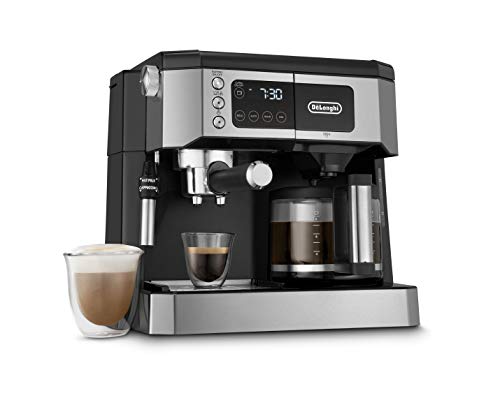
Runs espresso and a 10-cup drip pot from the same chassis, on separate heating paths.
Best for: a household where one person drinks drip and the other wants espresso Skip it if: you have no interest in a 10-cup carafe
De'Longhi lists this as an espresso and coffee maker combo, and the split matters. The listing describes a dual heating system that brews coffee and espresso simultaneously, a 15 bar pump on the espresso side, and a steam wand with a micro-foam setting for lattes and a cappuccino setting for foamed milk. There is a digital touchscreen and a 24-hour programmable timer, so the drip side can be waiting for you at 6:45 a.m. while you pull an espresso fresh. At 13.7 lb and 12.8 × 14.5 × 11 in, it is heavier than the small semi-automatics but not the deepest machine in the set. The trade-off against the Barista Express is real: there is no built-in grinder, so a serious espresso drinker still needs one on the counter. It is the second-most expensive pick here.
Pros:
- Two heating paths, drip and espresso in parallel
- 10-cup drip carafe listed
- 24-hour programmable timer on the drip side
- 15 bar pump claim on the espresso side
- Digital touchscreen interface
Cons:
- No grinder, so beans need a separate mill
- 14.5 in of depth needed on the counter
- No published warranty term in the listing
- The espresso side is second to a dedicated machine
4. Breville Bambino (BES450BSS) — Best for beginners
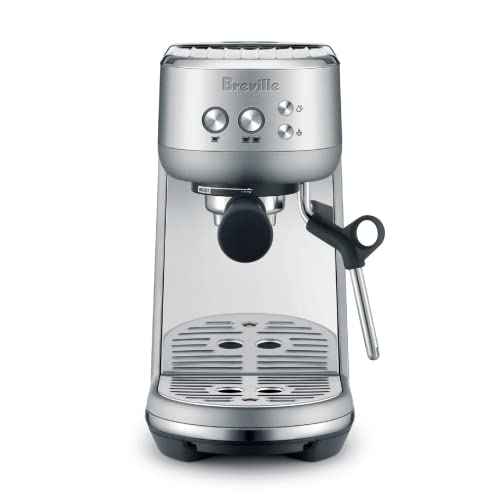
The Barista Express's steam and PID logic in a body a third of the weight.
Best for: first-time espresso buyers who want a fast heat-up and automatic milk texturing Skip it if: you want a built-in grinder
The Bambino is 10.9 lb and 12.2 × 12.6 × 7.7 in, which is roughly half the volume of the Barista Express and about a third of its depth-to-width footprint. Breville lists its ThermoJet heating system as reaching extraction temperature in 3 seconds, and pairs it with the same PID regulation and low-pressure pre-infusion claims as the bigger machine. The steam wand is described as automatic, so it targets a preset milk temperature and texture rather than asking you to feel the pitcher. For a two-person household new to espresso, that removes the two hardest variables: waiting for the boiler and reading milk by ear. The compromise is the missing grinder. You will pair this with a burr mill on the counter, and the total footprint climbs. One-year manufacturer warranty listed.
Pros:
- ThermoJet 3-second heat-up is a stated claim
- Automatic milk texturing removes a learning step
- 7.7 in of depth, shallowest Breville here
- PID temperature regulation listed
- One-year warranty stated
Cons:
- No integrated grinder
- 12.2 in width still needs real counter space
- Priced in the premium band despite the small size
- Single boiler, so back-to-back doubles need patience
5. CASABREWS CM5418 — Best minimal setup
The lightest semi-automatic here, aimed at kitchens where the machine has to disappear.

Best for: a small kitchen where the machine has to disappear when it is not in use Skip it if: you want a stated warranty in plain English
The CM5418 is 8.59 lb, with a listed dimension of 4.71 × 4.83 × 2.32 in that I read as the boxed or product-card measurement rather than a full working footprint, because a semi-automatic with a portafilter and steam wand cannot occupy under three inches of depth. CASABREWS lists a 20 bar Italian pump and a 1350 W boiler on the machine, plus a milk-texturing steam wand. The listing includes a warranty statement, phrased informally, saying the seller provides one year of coverage. It is the second-cheapest pick after the CASABREWS 3700 and mid-pack by sales rank. Against the Breville Bambino it saves counter weight and price, and gives up the ThermoJet 3-second claim and the automatic wand. The listing also warns against brewing coffee immediately after frothing milk, which is a genuine single-boiler constraint.
Pros:
- Lightest weight of the two-person set at 8.59 lb
- 20 bar pump and 1350 W boiler are listed claims
- Milk-texturing steam wand included
- Warranty offered by the seller
- Entry price band
Cons:
- Listing dimensions read as boxed, not working
- Single boiler means a wait between milk and shot
- Warranty language is informal rather than a stated term
- Only one seller lists it
6. atatix EM3111 — Best for pros
Manual extraction control at an entry price, for someone who already knows what they're doing.

Best for: someone who wants manual shot control at an entry price Skip it if: you want a bean hopper or a programmable interface
The atatix is the lightest machine here at 7.5 lb, with a working footprint of 11.2 × 12.2 × 5.5 in. Where the other entry-price picks in this set lean on preset buttons, atatix's listing highlights a manual extraction mode alongside auto: the operator sets shot time by hand. The listing also claims an NTC precision temperature system targeting 90 to 96 °C with a 30-second preheat, and describes the steam wand as delivering dry, focused steam. Those are the vocabulary a barista-first buyer reads for. One-year manufacturer warranty listed. Against the Bambino, this gives you a manual timing dial the Breville does not surface, and gives up the automatic milk wand and the ThermoJet claim. It is the second-cheapest pick and among the slower sellers here.
Pros:
- Manual extraction dial listed
- 90-96 °C target temperature is a stated claim
- 7.5 lb, easy to move
- Steam wand for microfoam listed
- One-year manufacturer warranty
Cons:
- Manual mode assumes prior espresso experience
- No grinder, no bean hopper
- Single boiler, so milk and shot need sequencing
- Slower seller in this set
7. CASABREWS 3700 Essential — Best budget pick
The cheapest pick of the seven, for testing whether espresso becomes a real habit.

Best for: a couple testing whether espresso becomes a real habit before spending more Skip it if: you want a published warranty and a bigger drip tray
The 3700 Essential is the cheapest pick here and, at 8.14 lb, one of the lightest. CASABREWS lists a 20 bar pump, a 1350 W heating system and a milk-texturing steam wand, and the listing describes the machine as a semi-automatic two-in-one that fits any kitchen size. It also spells out a "first-use cycle" instruction to remove a rubber plug at the bottom of the water tank before first brewing, which is a useful warning to have in the box. The 3700 does not list a warranty term, unlike its CASABREWS sibling above, which is worth knowing at this price position. It is the fastest seller among the CASABREWS pair here. Against the CM5418, it trades the stated warranty for a lower price and a similarly small body. Fine as a starter; not a machine to build a routine around for years.
Pros:
- Cheapest of the seven picks
- 20 bar pump and 1350 W boiler are listed claims
- 8.14 lb, easy to move for cleaning
- Milk steam wand included
- Faster seller than the CM5418
Cons:
- No published warranty term
- Listing dimensions read as boxed rather than working
- Single boiler with the usual wait
- Only one seller lists it
Semi-automatic, capsule or combo: which shape fits?
Three shapes sit inside this shortlist, and they solve different problems.
- Semi-automatic espresso machines are the five picks with portafilters and steam wands: the Breville Barista Express, Breville Bambino, CASABREWS CM5418, atatix EM3111 and CASABREWS 3700. You grind, dose, tamp, lock and pull. The Barista Express folds the grinder into the machine. The others assume you bring your own.
- Capsule brewers are the Nespresso Vertuo Next. You drop in a sealed capsule and press a button. No grinder, no tamp, no wand. Faster morning, less control, ongoing capsule cost.
- Combo machines are the De'Longhi COM532M. Drip on one side, espresso on the other, sharing a chassis and a footprint. Better for households where the two drinkers want different drinks at the same time.
A pure espresso household picks a semi-automatic. A speed-first household picks the capsule. A mixed household picks the combo. That is genuinely most of the decision.
How much counter space are you really giving up?
Depth is the counter-space number that catches people out, because most kitchens have shallow uppers that clip the portafilter handle. Working from the listing dimensions, the picks sort like this from shallowest to deepest:
- Bambino, 7.7 in deep.
- Bambino and CASABREWS entry pair are the smallest overall bodies, though CASABREWS listings read as boxed rather than working footprints.
- atatix, 12.2 in deep on the long axis.
- De'Longhi COM532M, 14.5 in deep, but that includes the drip carafe.
- Barista Express, 13.8 in wide by 12.5 in deep, plus a bean hopper on top.
- Vertuo Next, 16.9 in deep but only 5.5 in wide, so it slots against a wall.
Measure from the wall to the front edge of your counter before you pick. Under 14 inches of usable depth means the Barista Express and the De'Longhi combo will overhang, and a portafilter is not something you want cantilevered.
Which pick wins if you drink milk drinks daily?
Milk changes the answer. Every semi-automatic in this set lists a steam wand, but they are not equivalent.
The two Breville machines list PID temperature regulation and, in the Bambino's case, an automatic wand that targets preset milk temperatures. The De'Longhi combo describes micro-foam and cappuccino settings on its steam wand. The CASABREWS and atatix machines describe powerful steam wands with claims about dry steam and microfoam, and add the important caveat that the boiler needs to cool between steaming milk and pulling a shot.
For two people making a latte each every morning, the sequence matters. A single-boiler machine wants: heat, pull the two shots, switch to steam, do both milks, serve. A Breville with PID regulation makes that sequence more forgiving. A capsule machine like the Vertuo Next does not steam milk at all, so you would pair it with a standalone frother if you want cappuccinos.
The verdict
The best premium espresso machine for two people is the Breville Barista Express. Its 22.1 lb chassis stays still under portafilter torque, its integrated conical burr grinder feeds a 2-cup filter without a detour to a separate mill, and its PID temperature and low-pressure pre-infusion claims give a repeatable shot from cup one to cup two.
If you would rather trade fresh grinding for speed, the Nespresso Vertuo Next is the runner-up. It is 8.8 lb, 5.5 in wide, and covers six drink sizes across espresso and coffee from a capsule. A second drink is a swap-and-press, not a regrind.
If your household is genuinely split between espresso and drip, the De'Longhi COM532M wins on parallelism: its dual heating system runs both sides at once, so nobody waits. And if you are new to espresso, the Breville Bambino delivers the PID and automatic-wand story in a 7.7 in-deep body at a lower price than the Barista Express. The cutoff between the Bambino and the Barista Express is the grinder. If you already own one, buy the Bambino. If you don't, the Barista Express is one purchase instead of two.
FAQ
Is a premium espresso machine worth it for two people?
A premium espresso machine is worth it for two people if you make more than one milk drink a day between you and plan to keep making them for years. Below that threshold, a capsule brewer like the Vertuo Next answers the same question for less commitment. Above it, the built-in grinder and PID regulation on a Barista Express pay back in shots that taste the same on Tuesday and Sunday.
Which is better for a couple, the Breville Barista Express or the Bambino?
The Breville Barista Express is better for a couple that does not already own a burr grinder, because it builds one into the 22.1 lb chassis. The Bambino is better if you have a grinder, because it delivers the same PID temperature regulation and low-pressure pre-infusion claims in a 10.9 lb, 7.7 in-deep body. Same espresso story, different footprint and different total spend.
How much counter depth do I need for these machines?
You need at least 14 inches of usable counter depth for the Breville Barista Express, which lists a 12.5 in depth plus a bean hopper on top. The De'Longhi COM532M lists 14.5 in of depth including its drip carafe. The Bambino is the shallowest semi-automatic at 7.7 in. The Vertuo Next is only 5.5 in wide but 16.9 in on its long axis.
Do any of these machines have a warranty?
Four of the seven machines list a warranty term. The Nespresso Vertuo Next, Breville Bambino and atatix EM3111 each list a one-year manufacturer warranty. The CASABREWS CM5418 listing describes seller-provided one-year coverage in informal wording. The Breville Barista Express, De'Longhi COM532M and CASABREWS 3700 do not publish a warranty term in the listing, which is worth confirming before you buy.
What's the biggest mistake shoppers make in this category?
The biggest mistake shoppers make is comparing pump bar ratings. Every machine here lists 15 or 20 bar, and the puck sees around 9 bar in a real shot regardless. What actually decides a two-person purchase is boiler recovery, grinder integration and counter depth. Read the temperature control claim, the grinder story and the working footprint before the bar number, and the shortlist narrows fast.
The next step is a tape measure, not a checkout button. Measure the counter depth under your uppers, then decide whether you already own a burr grinder. Those two answers pick your machine. A household with 14 inches of clear counter and no grinder buys the Barista Express and finishes the espresso setup in one purchase. A household short on depth or short on time buys the Bambino or the Vertuo Next and moves on. The reason the Barista Express is the default winner for two people is not that it is the fanciest machine here. It is that it removes the second appliance from the equation.