Best Pesto Mortar and Pestle: ChefSofi Leads

Five mortar and pestle sets ranked for pesto making, from a 7.05 lb granite bowl to a 1.9 lb stainless steel option. Here is which one actually crushes basil best.

By Jody SargentUpdated 15 min read
On this page
- Best pesto mortar and pestle at a glance
- Who should skip a mortar entirely
- Granite, marble or stainless: what actually crushes basil
- 1. ChefSofi Mortar and Pestle Set — Best overall
- 2. Priority Chef Heavy Duty Large 4 Cup Mortar and Pestle Set — Best premium
- 3. IMUSA USA Small Polished Mortar and Pestle — Best for families
- 4. HIC Kitchen Mortar and Pestle Set — Best budget pick
- 5. Tera 18/8 Stainless Steel Mortar and Pestle with Brush — Best lightweight
- How big does the bowl need to be for pesto?
- How I narrowed the field to five
- Care, seasoning and the mistakes that ruin a new mortar
- The verdict
- FAQ
The best pesto mortar and pestle is the ChefSofi Mortar and Pestle Set, a 7.05 lb granite bowl with a 2-cup capacity that anchors to the counter and gives basil, garlic and pine nuts room to break down into a proper paste. If you cook for six or you make a quart of pesto at a time, the 4-cup Priority Chef set is the better buy. Who this is not for: anyone who wants a food processor's speed. Buy a small processor instead, keep the mortar for garlic paste.
Best pesto mortar and pestle at a glance
| Pick | Material | Bowl capacity | Weight | Price |
|---|---|---|---|---|
Best overall ChefSofi Mortar and Pestle Set |
Granite | 2 cups | 7.05 lb | Check Price |
Best premium Priority Chef Heavy Duty Large 4 Cup Set |
Granite | 4 cups | 11.7 lb | Check Price |
Best for families IMUSA USA Small Polished Mortar and Pestle |
Granite | 3.75 in bowl | 2.36 lb | Check Price |
Best budget pick HIC Kitchen Mortar and Pestle Set |
Carrara marble | 3.8 in bowl | 2.13 lb | Check Price |
Best lightweight Tera 18/8 Stainless Steel Mortar and Pestle |
18/8 stainless steel | 250 ml claim | 1.9 lb | Check Price |




Who should skip a mortar entirely
Pesto in a mortar takes 10 to 15 minutes. A food processor takes 90 seconds. If speed matters more to you than texture, a mortar is the wrong tool. Buy a mini chopper.
The people who should stay are the ones chasing texture. A mortar bruises basil, it does not shred it. That difference shows up as colour: hand-pounded pesto stays greener because the leaves are not oxidised by whirring blades. It shows up in mouthfeel too, because the pine nuts break unevenly and hold a little bite.
- Skip a mortar if your pesto is a weeknight rush and you already own a processor.
- Choose one if you cook Italian, Thai or Mexican weekly and want garlic paste, curry paste and salsa from the same bowl.
- Choose one if you enjoy the process. That sounds soft, but half the point is the ten minutes at the counter.
The rest of this guide assumes you have made the call to buy one. What varies from here is which one.
Granite, marble or stainless: what actually crushes basil
Basil is not a spice. It is a leaf, and it does not need a rough surface to shatter. It needs weight above it and a bowl deep enough that leaves cannot climb the sides. Most guides compare mortars on hardness. That is not what decides pesto.
Weight decides pesto. Of the five picks, three tell the story clearly:
- Priority Chef at 11.7 lb: stays put through the whole grind, no free hand needed.
- ChefSofi at 7.05 lb: heavy enough to anchor a 2-cup bowl without steadying it.
- Tera stainless steel at 1.9 lb: needs the padded base to stay honest, and even then a firm strike will shift it.
Material still matters, but for different reasons. Granite is the most forgiving choice for pesto because the interior is unpolished enough to grip a basil leaf without being so rough it holds oil. The ChefSofi, IMUSA and Priority Chef sets are all granite. HIC uses Carrara marble, which is denser and prettier but a touch more slippery for leafy work. Tera's stainless steel is the outlier: fine for pills and dry spices, but a smooth metal bowl is not the surface pesto wants.
The short version: for pesto, pick granite first, marble second, stainless last.
1. ChefSofi Mortar and Pestle Set — Best overall
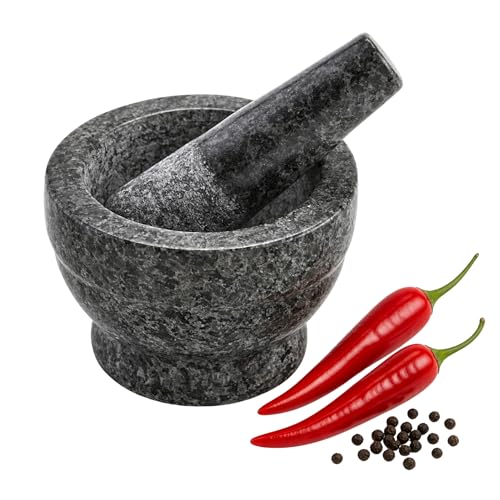
A 7.05 lb granite bowl with a 2-cup capacity is the sweet spot for weekly pesto.
Best for: weekly pesto batches for two to four people Skip it if: you cook for a crowd or need to grind dry spices fine
The ChefSofi lands where most home cooks actually live: enough capacity for a full basil bunch, enough weight to sit still, small enough to store in a normal cupboard. The bowl measures 6 x 6 x 6 in with 2 cups of working room, and at 7.05 lb it does not walk across the counter when you drop your shoulder into a grind. That combination is why it is the pick.
ChefSofi describes it as a granite set built to stay still through the grinding process, which the weight-to-size ratio backs up. It is the second-heaviest bowl of the five, but it is far less bulky than the 11.7 lb Priority Chef, so it earns its counter space in a way the bigger set does not for most households. It sells faster than three of the other four picks here, which is a fair sign the size matches what buyers actually need.
The trade-off is honest: if you make pesto for eight, you will need two batches, and the interior is not fine enough to produce a proper cardamom powder. Neither is a pesto problem.
Pros:
- 7.05 lb anchors the bowl without a helper hand
- 2-cup capacity fits a standard basil bunch
- Granite interior grips leaves and garlic
- The one buyers here reach for most often
- Compact 6-inch footprint stores easily
Cons:
- Too small for double batches
- Only one seller lists it right now
- Sits in the higher price position for a mid-size bowl
- No published warranty
2. Priority Chef Heavy Duty Large 4 Cup Mortar and Pestle Set — Best premium
Four cups of capacity and 11.7 lb of granite make this the pick for big-batch cooks.

Best for: big-batch pesto, guacamole and salsa cooks Skip it if: counter space is tight or your wrist tires easily
Priority Chef doubles the working room and adds four and a half pounds over the ChefSofi. The bowl is 7 in across, the pestle is 7.2 in long, and the whole set weighs 11.7 lb. That is enough mass to grind through a full bunch of basil, three garlic cloves and a handful of pine nuts without pausing to scrape the sides, because there is room for the pestle to travel.
Priority Chef says the bowl handles guacamole, salsa and pesto in one vessel, and the dimensions support that: 4 cups is a small-batch guacamole party in one go. The set also ships as a two-piece count, which the listing highlights, and comes in black granite that hides staining better than the paler stones. It is the highest price position of the five picks here.
The catch is real. At 11.7 lb this is not the bowl you lift down from a shelf mid-cook. Leave it out, and Priority Chef notes it can scratch a countertop, so a cloth or trivet underneath is worth thinking about. Wrist strain is the other honest concern: a heavier pestle amplifies your force but also your fatigue.
Pros:
- 4-cup capacity handles double pesto batches
- 11.7 lb bowl does not move under any grind
- 7.2 in pestle gives real leverage
- Black granite hides basil staining
- Two-piece set with a sturdy pestle
Cons:
- Highest price position of the five
- Heavy enough to want a permanent counter spot
- Can scratch countertops if left out unprotected
- Overkill for a household of one or two
3. IMUSA USA Small Polished Mortar and Pestle — Best for families
A 3.75-inch granite bowl that fits small kitchens and small pesto jobs.
Best for: small kitchens making pesto for one or two Skip it if: you want a bowl that swallows a full basil bunch
The IMUSA is the compact granite pick. The bowl is 3.75 in across, the whole set weighs 2.36 lb, and the footprint is roughly 4 x 4 in. That is a bowl that lives in a drawer, not on the counter. For a single portion of pesto over pasta for two, it is enough room to work.
IMUSA says the interior is rough textured for effective grinding, and pairs it with a polished exterior. The listing also mentions gift box packaging, which matters if you are buying for someone starting out. Compared with the ChefSofi and Priority Chef, this is the granite pick you choose for storage, not for capacity.
Where it loses ground is basil volume. A packed cup of basil leaves will crowd this bowl, and you will end up working the pestle awkwardly against the wall while leaves escape over the rim. It also weighs less than a third of the ChefSofi, so you will feel it try to shift under a hard downstroke. The 3.75-inch size is the right call for garlic paste, ginger, peppercorns and a modest pesto, not for a Sunday sauce for six.
Pros:
- Compact 3.75 in bowl fits any kitchen
- Granite interior grips herbs and garlic
- 2.36 lb is easy to move to the sink
- Ships in a gift box
- Works for dry spices as well as pastes
Cons:
- Bowl too small for a full basil bunch
- Light enough to slide under hard strikes
- Polished exterior can feel slick when wet
- No published warranty
4. HIC Kitchen Mortar and Pestle Set — Best budget pick
Carrara marble at the lowest price position here, sized for light pesto duty.

Best for: occasional pesto, garlic paste and pill crushing Skip it if: you plan to grind hard spices or nuts daily
The HIC is the entry into stone. The bowl is 3.8 in across, the pestle is 4 x 2.5 in, and the whole set weighs 2.13 lb in solid Carrara marble. HIC says it grinds spices, herbs, nuts and seeds into a fine paste or powder, and lists pesto, curry paste, guacamole and salsa among the intended uses. As a first mortar for someone who has never owned one, it is a reasonable first stone.
Marble is the honest reason this pick sits at fourth. It is beautiful and it is dense, but the interior is smoother than the granite picks and pesto works best on a rougher surface. The lower weight also matters: 2.13 lb is the lightest stone here, and a light bowl needs a steadying hand on a hard grind. For a small batch of basil pesto or a garlic paste, it does the job. For grinding peppercorns or hard nuts several times a week, the marble will polish faster than granite would.
The cheapest of the five stones, and the second-slowest seller of the set, which is worth knowing when you set expectations against the ChefSofi.
Pros:
- Entry price position for a real stone bowl
- Carrara marble looks better on a counter than most
- 3.8 in bowl handles small pesto batches
- Solid stone, not a resin composite
- HIC lists pesto explicitly among uses
Cons:
- Marble is smoother than granite for basil
- 2.13 lb is light enough to shift under hard strikes
- Will polish over time with heavy spice grinding
- No published warranty
5. Tera 18/8 Stainless Steel Mortar and Pestle with Brush — Best lightweight
A 1.9 lb stainless steel bowl that is easier to store than it is to make pesto in.

Best for: renters, RV kitchens, anyone with wrist strain Skip it if: you want a rough interior that grips basil leaves
The Tera is the only non-stone pick here, and it earns its place by weight. At 1.9 lb it is the lightest of the five, and Tera bundles a brush and a translucent lid in a three-piece count. The listing also names a lifetime warranty, the only warranty statement in the set, which is a real point for a shopper who wants recourse if the bowl dents.
Tera describes the steel as 18/8 food grade, rustproof and resistant to acidic foods. That last claim matters more than it sounds: a garlic-and-lemon paste will not stain or etch steel the way it will polish stone. The translucent lid, Tera says, keeps contents in the bowl during hard strikes.
The honest problem for pesto is the interior. Smooth stainless steel does not grip basil the way an unpolished granite surface does, so leaves slide up the wall of the bowl and escape the pestle. This is a fine pill crusher, a fine peppercorn grinder, a fine bowl for a small dry spice blend. It is the wrong first choice for someone whose main job is pesto. Bought as a second, lighter bowl for travel or a small kitchen, it makes more sense.
Pros:
- 1.9 lb is the lightest bowl here
- Rustproof and stain-resistant steel
- Lifetime warranty from the seller
- Three-piece set with brush and lid
- Fits in a drawer or a travel bag
Cons:
- Smooth steel is the wrong surface for basil leaves
- Light enough to need the padded base to stay put
- 250 ml capacity is a manufacturer claim, not a standardised figure
- Sits at the bottom of the set for pesto specifically
How big does the bowl need to be for pesto?
The classic Genovese recipe uses roughly 50 grams of basil leaves, two garlic cloves, a small handful of pine nuts, salt, cheese and oil. That fits into a 2-cup bowl with room to work.
Here is the sizing rule I use with these five picks:
- Under 2 cups (IMUSA, HIC, Tera): a single-serve portion of pesto for pasta for two. Fine for garlic paste.
- 2 cups (ChefSofi): a full basil bunch, four servings of pesto, room for the pestle to travel.
- 4 cups (Priority Chef): double batches, guacamole for a party, salsa.
The trap is buying too small because a small mortar looks cheaper on a shelf. A 3.75-inch bowl will make pesto, but leaves will crowd the walls and you will grind slower because you are also holding leaves in. A 2-cup bowl is the point where the tool stops fighting you.
If you cook Italian or Thai food weekly, buy the 2-cup ChefSofi. If you host, buy the 4-cup Priority Chef. If pesto is a summer thing you do three times a year, the HIC will not embarrass itself.
How I narrowed the field to five
I started with the mortar and pestle category on Amazon and applied three cuts, in order.
- Material. Anything not stone or solid metal came out. Wood mortars stain and hold oil, ceramic mortars chip, and resin composites polish quickly. That left granite, marble and stainless steel.
- Weight relative to size. A bowl needs to sit still under a grind. The rule was roughly 3 lb per cup of capacity for stone, with a hard floor at 2 lb for any bowl over 3 inches wide. Two picks fell out here for being too light for their footprint.
- Capacity split. I wanted at least one pick under 2 cups for small kitchens, one at 2 cups for the mainstream, and one at 4 cups for entertaining. The ChefSofi, IMUSA, HIC and Priority Chef filled that split cleanly.
The Tera stainless steel set survived as an outlier because it is the only pick a renter can travel with, and because it is the only one with a stated warranty. It is not the pesto winner, and the write-up says so.
Two things I did not weight: colour and gift packaging. Both are real, both matter to some buyers, and neither decides how a bowl performs on basil.
Care, seasoning and the mistakes that ruin a new mortar
New stone mortars shed grit. That grit is not decorative, and it will end up in your first pesto if you skip seasoning.
The routine is short. Rinse the new bowl in warm water without soap. Grind a tablespoon of white rice into powder, tip it out, and repeat with a fresh tablespoon until the powder comes out white instead of gray. That is usually three to five rounds for granite, one or two for marble. Then grind a garlic clove and a pinch of salt to a paste and rinse. The bowl is ready.
Three mistakes worth avoiding:
- Soap in the bowl. Stone is porous and holds soap flavour longer than it holds garlic. Warm water and a stiff brush is the routine HIC and others recommend, and it is enough.
- Dishwasher. None of these belong in a dishwasher. Even the stainless steel Tera will lose its padded base.
- Storing wet. Marble in particular will develop dull patches if it sits in a puddle. Air-dry upside down.
Pesto specifically stains any stone slightly green for the first few uses. That fades. Black granite (the Priority Chef) hides it best; Carrara marble (the HIC) shows it longest.
The verdict
The ChefSofi Mortar and Pestle Set wins for pesto. Its 2-cup capacity fits a real basil bunch, its 7.05 lb weight keeps the bowl still, and its 6-inch footprint stores in a normal cupboard. It is the pick for the household that will make pesto every week or two, and it is the pick for anyone who wants one mortar to cover pesto, garlic paste and small spice work without owning two bowls.
Two conditions flip it. If you cook for a crowd or you make guacamole and salsa alongside pesto, the Priority Chef 4-cup set is the correct upgrade: an extra 4.65 lb of granite and a 7-inch bowl handle a double batch in one grind. If you cook alone in a small kitchen and pesto is occasional, the IMUSA in granite or the HIC in marble is enough tool, and the drawer they fit in is not a small thing.
Skip the Tera unless you have a specific lightweight or travel reason to want steel. It is a good bowl for pills and dry spices, but pesto wants a rougher surface than stainless can offer.
FAQ
Is a mortar and pestle worth it just for pesto?
A mortar and pestle is worth it for pesto if you make it more than three or four times a year and you care about the greener colour and coarser texture that hand-pounding gives. A processor is faster and finer, but it oxidises the basil and turns the sauce a duller green. The 10 to 15 minutes at the mortar is the trade.
Granite or marble for pesto sauce?
Granite is the better material for pesto sauce because the interior surface is unpolished enough to grip a basil leaf as the pestle comes down. Marble is denser and prettier, but the smoother interior lets leaves slide up the wall of the bowl. Three of the five picks here are granite, including the ChefSofi winner and the 4-cup Priority Chef.
How does the ChefSofi compare to the Priority Chef for a family?
The ChefSofi and the Priority Chef differ mainly in capacity and weight. The ChefSofi holds 2 cups and weighs 7.05 lb; the Priority Chef holds 4 cups and weighs 11.7 lb. For a family of three or four making pesto weekly, the ChefSofi is enough. For six or more, or for guacamole parties, step up to the Priority Chef and give it a permanent counter spot.
What size mortar do I need for a full basil bunch?
For a full standard basil bunch, roughly 50 grams of leaves, you need at least a 2-cup mortar to have room for the pestle to travel. Anything under a 4-inch bowl will work, but leaves will crowd the walls and slow you down. The ChefSofi at 2 cups is the smallest of these five picks that comfortably handles a full bunch in one go.
Can I use a stainless steel mortar and pestle for pesto?
You can use a stainless steel mortar for pesto, but the smooth interior fights basil leaves rather than grips them. Tera says its 18/8 steel is rustproof and stain-resistant, which is true and useful for pills, peppercorns and dry spice blends. For pesto specifically, a granite bowl like the ChefSofi will finish a paste faster and cleaner than the same effort in steel.
Take an honest look at your basil habit before you buy. If you grow it and use it every Sunday, spend the extra and get the ChefSofi: the weight, the 2-cup room, and the granite grip are the three things a pesto bowl actually needs, and this one has all three at a size you can store. If you already know you will double every batch, jump straight to the 4-cup Priority Chef and clear the counter space. Order tonight, season the bowl with rice and a garlic clove tomorrow, and by the weekend you will have a mortar that finishes a pesto in ten minutes and lasts a decade.