Best Mortar and Pestle for Everyday Cooking

Five granite and marble mortars ranked for daily kitchen work, with the bowl size, weight and pestle length that actually decide which one earns counter space.

By Jody SargentUpdated 14 min read
On this page
- Best mortar and pestle for everyday cooking at a glance
- How I cut the field down to five
- 1. ChefSofi Mortar and Pestle Set — Best overall
- 2. Priority Chef Heavy Duty Large 1.5 Cup Mortar and Pestle — Best upgrade
- 3. WALDWERK Mortar and Pestle — Best premium
- 4. IMUSA USA Small Polished Mortar and Pestle — Most versatile
- 5. HIC Kitchen Mortar and Pestle Set — Best budget pick
- Granite, marble or a wood-based hybrid?
- Why bowl volume matters more than diameter
- How much counter space are you giving up?
- What the listings don't tell you about seasoning
- Which pick suits your kitchen?
- The verdict
- FAQ
The best mortar and pestle for everyday cooking is the ChefSofi Mortar and Pestle Set, a 2-cup gray granite bowl weighing 7.05 lb that stays put through a full batch of pesto without walking across the counter. The misconception is that bowl diameter decides this. It doesn't: capacity and weight do, which is why a heavy 2-cup granite bowl beats a wider but lighter marble one for the pastes most home cooks actually make.
Best mortar and pestle for everyday cooking at a glance
| Pick | Capacity | Material & weight | Price |
|---|---|---|---|
Best overall ChefSofi Mortar and Pestle Set |
2 cups | Granite, 7.05 lb | Check Price |
Best upgrade Priority Chef Heavy Duty 1.5 Cup Set |
1.5 cups | Granite, 5.49 lb | Check Price |
Best premium WALDWERK Mortar and Pestle |
6.1 in bowl | Granite on oak base | Check Price |
Most versatile IMUSA Small Polished Mortar and Pestle |
3.75 in bowl | Granite, 2.36 lb | Check Price |
Best budget pick HIC Kitchen Marble Set |
3.8 in bowl | Carrara marble, 2.13 lb | Check Price |



How I cut the field down to five
Three cuts got me from the wider mortar and pestle category down to these five. First, I dropped anything without a published weight or bowl size, because you cannot judge a grinder you cannot compare. Second, I cut ceramic and wooden bowls: for everyday cooking, they either chip under garlic or absorb oil from pesto and go rancid. Third, I cut anything with a bowl smaller than 3.75 in, because a smaller bowl launches peppercorns onto the floor.
That left three granite sets, one granite-on-oak hybrid, and one marble set. The five split cleanly by capacity: one 2-cup bowl, one 1.5-cup bowl, and three smaller bowls sized in inches rather than cups. Weight ranges from 2.13 lb to 7.05 lb across the set, which is a bigger spread than most buyers expect.
Everyday cooking is a loose qualifier and Amazon's search treated it loosely. What survived the cuts is a set of mortars that can handle the jobs most kitchens actually run: garlic, herbs, whole spices, and the occasional bowl of guacamole or pesto. Whether that matches your everyday is up to you to judge from the capacity and weight below.
1. ChefSofi Mortar and Pestle Set — Best overall
A 2-cup granite bowl that's heavy enough to grind against, priced squarely in the middle of this set.
Best for: cooks who grind pesto, curry paste and guacamole most weeks Skip it if: you want something that stores in a drawer
The ChefSofi wins on the two figures that decide this category for everyday cooking: 2-cup capacity and 7.05 lb of granite. That is the largest bowl and the heaviest body in this set, and the combination is what lets you lean into a pestle without the mortar sliding or a batch of basil climbing the walls. The 6 x 6 x 6 in footprint is a square block on the counter, so it lives out, not in a cupboard.
Granite is the material you want for daily work. It doesn't stain like marble and doesn't crack under sustained pounding, and ChefSofi describes it as durable and heavy enough to stay put during grinding, which the 7.05 lb figure backs up. It's also the one buyers reach for most often in this set by a wide margin.
The trade-off is bulk. This is not a discreet tool, and at 7.05 lb it is heavier than most cookware you'd pick up one-handed. Against the Priority Chef it gives up a slightly smaller pestle length in exchange for a bigger bowl; against the WALDWERK it gives up the built-in wooden base.
Pros:
- Largest capacity in this set at 2 cups
- Heaviest bowl at 7.05 lb, no walking during grinding
- Granite handles acidic pastes without staining
- Sits mid-range for price, not premium
- The one buyers here choose most often
Cons:
- 6 x 6 x 6 in footprint dominates a small counter
- Too heavy to lift comfortably with one hand
- No published warranty in the listing
2. Priority Chef Heavy Duty Large 1.5 Cup Mortar and Pestle — Best upgrade
A 5.5 in granite bowl paired with a 6.2 in pestle, at a premium price point but a smaller footprint than the ChefSofi.

Best for: people who want a heavier bowl without a huge footprint Skip it if: you already own a granite set that works
Priority Chef publishes the numbers you actually need: a 1.5 cup bowl at 5.5 in across and 2.2 in deep, with a 6.2 in pestle. That pestle is the longest in this set, and Priority Chef says the length keeps your knuckles clear of the rim, which matters when you're grinding for more than a minute. Weight lands at 5.49 lb, second-heaviest here after the ChefSofi.
The black granite finish is a look, not a function, but the listing notes it can scratch a countertop if you slide it around, so treat this one like a small piece of furniture rather than a tool you drag out and stow. It sits in the premium price band alongside the WALDWERK, which is why it's the upgrade pick rather than the winner: you're paying more for a slightly smaller bowl than the ChefSofi.
Against the ChefSofi, the trade is 0.5 cups of capacity for a smaller 3 x 5.5 x 5.5 in footprint and a longer pestle. That's a good trade if counter space is tight. If it isn't, the extra capacity wins.
Pros:
- 6.2 in pestle, longest in this set
- Deep 2.2 in bowl holds a full pesto batch
- 5.49 lb of granite for a stable grind
- Smaller footprint than the ChefSofi
Cons:
- Premium price band for less capacity than the winner
- Can scratch a countertop if slid
- No non-slip base rubber mentioned in specs
3. WALDWERK Mortar and Pestle — Best premium
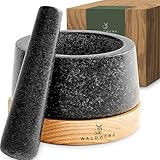
A 6.1 in granite bowl on an oak wood base, the only set here with a built-in surface protector and a stated 60-day money-back offer.

Best for: open shelves and long grinding sessions Skip it if: you want a published weight before buying
WALDWERK is the design pick. The 6.1 in granite bowl sits in a wide oak base, which the brand says protects your counter from scratches and keeps the mortar planted during grinding. It's also the only pick here that pairs a stone bowl with a wooden platform, so if the black-granite-on-butcher-block look isn't for you, this is the one you want on the shelf.
The listing runs 7.48 x 5.12 x 3.94 in overall, which includes the base, and WALDWERK claims an extra-long pestle so your hand clears the rim. Both of those match what a real cook needs from a mortar you use often. The brand also offers a 60-day money-back guarantee in the listing, which none of the others match. Granite, the brand notes, hardly absorbs water, which is why it cleans up faster than marble after garlic.
The catch is the missing weight figure. Every other pick publishes a weight; WALDWERK does not. For a category where heavier is better, that's the trade-off you're making for the wood base and the money-back offer.
Pros:
- Oak base protects the counter without a separate mat
- 6.1 in bowl, roomy for pesto and guac
- 60-day money-back offer stated in the listing
- Best-looking of the five on an open shelf
Cons:
- No published weight to compare against granite rivals
- Premium price band and the highest sales rank of the set
- Wood base means slightly more cleaning after wet pastes
4. IMUSA USA Small Polished Mortar and Pestle — Most versatile
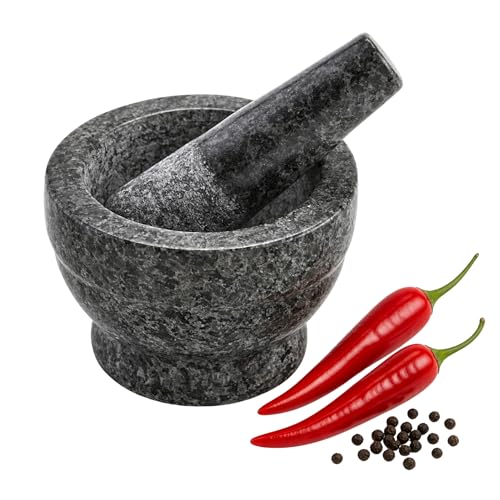
A 3.75 in polished granite bowl at 2.36 lb, the entry-priced everyday workhorse when you don't need a full pesto batch.
Best for: small kitchens and single-clove garlic jobs Skip it if: you regularly make pesto for four
IMUSA's 3.75 in bowl is the smallest granite option in this set, and that's the point. At 2.36 lb and 5 x 4.02 x 4.02 in, it fits in a cabinet and comes out for the jobs that make up most of a home cook's grinding: a clove or two of garlic, a spoonful of peppercorns, a small handful of herbs. IMUSA calls it a versatile tool for garlic, ginger, pepper, herbs and vanilla, and the size backs the claim.
Granite construction with a rough textured interior is what you want for grip on hard spices, and the polished exterior wipes clean. It sits in the entry price band alongside the HIC marble set, which puts it in the sweet spot for a first mortar and pestle. It's also the second-cheapest of the five.
The compromise is capacity. A 3.75 in bowl is not going to handle a batch of pesto for pasta night, and at 2.36 lb it won't sit as still as the 7.05 lb ChefSofi under heavy pounding. This is a companion piece to a larger mortar, or a standalone for a cook who mostly seasons rather than grinds pastes.
Pros:
- Compact 5 x 4.02 x 4.02 in footprint fits a drawer
- Granite handles garlic and peppercorns cleanly
- Entry price band, second-cheapest here
- Rough interior for grip on hard spices
Cons:
- Bowl too small for pesto or guacamole batches
- 2.36 lb is light enough to slide on a smooth counter
- No non-slip base
5. HIC Kitchen Mortar and Pestle Set — Best budget pick
A 3.8 in Carrara marble bowl at 2.13 lb, the cheapest of the five and the only marble pick in the set.

Best for: occasional cracked peppercorns and pill crushing Skip it if: acidic pastes like tomatillo salsa are on your weekly list
HIC is the cheapest of the six and the only marble bowl here. The 3.8 x 3.8 in bowl paired with a 4 x 2.5 in pestle is close in size to the IMUSA, but the material is different and it matters. HIC describes it as solid Carrara marble with a heavy stone design, and the listing lists uses from spice grinding to pill crushing. Weight comes in at 2.13 lb, the lightest of the five.
Marble looks better than granite for most kitchens and it's easier on the eye when it lives on the counter. It's also easier on the wallet: this is the entry price for the category, and if you grind whole peppercorns once a week and crush the occasional pill, this is enough mortar to do the job.
Here's the trade-off with marble. It's more porous than granite, so it stains under turmeric, tomatillo or heavily pigmented pastes, and it doesn't shrug off acidic ingredients the way granite does. The listing recommends hand washing in warm soapy water, and HIC does not publish a warranty. For everyday cooking that includes wet acidic pastes, granite is the safer material.
Pros:
- Cheapest of the five
- Solid Carrara marble looks good on a counter
- Rounded pestle head suits spices and pills
- Lightest at 2.13 lb, easy to move
Cons:
- Marble stains more readily than granite
- Lightest bowl in the set, slides more easily
- No stated warranty
Granite, marble or a wood-based hybrid?
Four of the five picks here are granite, and there is a reason. Granite is dense, hardly absorbs water (WALDWERK says as much in its listing), and shrugs off the acidic ingredients that show up constantly in everyday cooking: garlic, lime, tomatillo, tomato. Marble, the material HIC uses, is softer and more porous. It stains under turmeric and holds onto oil from pesto in a way granite doesn't.
The WALDWERK is the odd one out: granite bowl, oak wood base. The base doesn't touch your food, so it isn't a food-safety question. It is a counter-protection question. Granite on a wooden surface scrapes it. Granite in a wooden cradle doesn't.
Three rules of thumb:
- If you grind acidic or heavily pigmented ingredients weekly, choose granite.
- If you mostly crack whole spices or crush pills, marble is fine and cheaper.
- If your mortar lives on an open shelf or a butcher block, a wooden base earns its keep.
Why bowl volume matters more than diameter
Most listings publish diameter in inches, which is misleading. What you actually need is volume, because volume tells you whether a full pesto batch fits without launching leaves onto the counter. Only two picks here publish a cup measurement: the ChefSofi at 2 cups and the Priority Chef at 1.5 cups. The other three publish inches.
For a rough sense of scale:
- A single clove of garlic and a pinch of salt: any bowl in this set works.
- A tablespoon of whole peppercorns: 3.75 in and up works.
- A half batch of pesto for two: 1.5 cups minimum.
- Guacamole for four: 2 cups is comfortable, 1.5 cups is tight.
- A full curry paste with lemongrass and chilies: 2 cups, and you'll still be crowded.
Depth matters as much as diameter. Priority Chef publishes 2.2 in of depth in its listing, which is why the 1.5 cup bowl handles more than the raw diameter suggests. A shallow 3.8 in bowl holds far less than a deep one at the same width.
How much counter space are you giving up?
A mortar and pestle you use every day lives on the counter, because a 5-lb granite bowl doesn't belong in an overhead cupboard. That makes footprint a real cost.
- ChefSofi: 6 x 6 x 6 in
- Priority Chef: 3 x 5.5 x 5.5 in
- WALDWERK: 7.48 x 5.12 x 3.94 in (widest, because of the oak base)
- IMUSA: 5 x 4.02 x 4.02 in
- HIC: 2.5 x 4 x 4 in (smallest)
The WALDWERK is the widest overall thanks to the base, but the base is what earns it its shelf appeal. The ChefSofi is the tallest cube. The HIC is genuinely small enough to tuck into a drawer if you don't use it daily. If counter space is your binding constraint and you still want granite, Priority Chef's 3 x 5.5 x 5.5 in is the compromise: shallower footprint, still 1.5 cups of bowl.
What the listings don't tell you about seasoning
Every new granite mortar arrives with fine stone dust in the bowl. None of the listings here mention it, but a new granite bowl needs a break-in wash. The trick is grinding a handful of raw white rice to a powder, discarding it, wiping the bowl out, and repeating until the rice powder comes out white rather than gray. That usually takes three to four rounds.
Marble is different. HIC recommends hand washing in warm soapy water and drying thoroughly, and that's the whole routine. No rice.
A second thing most listings skip: never put a stone mortar in the dishwasher, and never use dish soap after grinding aromatic herbs. Soap gets into the pores of the stone and you'll taste it in your next batch of pesto. Warm water and a stiff brush is enough for daily cleanup on any of these five.
Which pick suits your kitchen?
Five picks, five kitchens:
- You make pesto or guacamole most weeks and have counter space: ChefSofi.
- You want a heavy granite bowl but the counter is small: Priority Chef.
- Your mortar lives on an open shelf and design matters: WALDWERK.
- You mostly grind whole spices and single garlic cloves: IMUSA.
- You want a mortar for occasional use at the lowest price: HIC.
Two questions decide it faster than any spec sheet:
- Do you grind pastes, or do you grind spices? Pastes want capacity. Spices want a rough interior.
- Does the mortar live out or in a cupboard? If out, footprint and looks matter as much as bowl size.
The verdict
The ChefSofi Mortar and Pestle Set is the best mortar and pestle for everyday cooking, and it isn't close for the cooks this article was written for. A 2-cup granite bowl at 7.05 lb is the combination that handles pesto, guacamole and curry paste without walking or overflowing, and it sits at a mid-range price that undercuts both premium picks here.
Two conditions flip the pick. If your counter space is genuinely tight and you'd trade half a cup of capacity for a smaller footprint, the Priority Chef Heavy Duty Large 1.5 Cup at 3 x 5.5 x 5.5 in with a 6.2 in pestle is the better buy. And if the mortar is going to live on an open shelf where it's seen daily, the WALDWERK's oak base earns its premium price by protecting the surface and looking like it belongs there.
Priority Chef's advantage over the winner is precise: the longest pestle in this set at 6.2 in, and a footprint that's an inch smaller each way. That is what you're buying, and if you don't need it, the ChefSofi's larger bowl is the better default for everyday cooking.
FAQ
Is a mortar and pestle worth it for everyday cooking?
A mortar and pestle is worth it if you cook with fresh garlic, whole spices or herbs more than once or twice a week. Pounding releases oils that a knife or grinder crushes and heats. For occasional use, the HIC marble set at entry pricing is enough. For weekly pastes, the ChefSofi's 2-cup granite bowl earns its counter space quickly.
How big should a mortar and pestle be for a home kitchen?
How big it should be depends on what you grind. For garlic, spices and small herb jobs, a 3.75 in to 4 in bowl works, which is where the IMUSA and HIC sit. For pesto, guacamole or curry paste for two to four people, aim for 1.5 to 2 cups of capacity. The ChefSofi's 2 cups is the roomiest here.
Is granite better than marble for a mortar and pestle?
Granite is better than marble for daily use with acidic and pigmented ingredients. WALDWERK notes that granite hardly absorbs water, which is why it doesn't stain under turmeric or tomatillo. Marble, like the HIC's Carrara, is softer and more porous, so it's fine for whole spices and pill crushing but less forgiving with wet acidic pastes.
ChefSofi vs Priority Chef: which is the better buy?
ChefSofi vs Priority Chef comes down to capacity against footprint. The ChefSofi holds 2 cups in a 6 x 6 x 6 in body at 7.05 lb, priced mid-range. The Priority Chef holds 1.5 cups in a 3 x 5.5 x 5.5 in body at 5.49 lb, priced premium. Choose ChefSofi for bigger batches and lower price. Choose Priority Chef for tighter counters and a longer 6.2 in pestle.
What's the biggest mistake people make choosing a mortar and pestle?
The biggest mistake people make is buying by looks and ending up with a bowl that's too light or too small. A 2 lb marble bowl slides under real pressure, and a 3.75 in bowl launches peppercorns onto the counter. Weight and volume are what decide daily use. Every pick in this guide publishes at least one of those figures for that reason.
Pick one and put it on the counter this week, because a mortar and pestle only earns its keep when it's within reach. For most cooks reading this, that means the ChefSofi: 2 cups of granite, 7.05 lb of stability, and a mid-range price that doesn't ask you to justify it. It will handle the garlic on Tuesday, the pesto on Thursday, and the guacamole on Saturday without complaint. The other four picks each answer a specific question about space, budget or design, and the table at the top of this guide is the fastest way to match one to your kitchen.