Best Espresso Machine for Seniors: Light and Simple

Seven espresso machines compared on the numbers that matter when hands get tired: weight, footprint, control count and published warranty. The CASABREWS CM5418 leads at 8.59 lb, with a 22.1 lb Breville as the counter-mounted alternative.

By Jody SargentUpdated 18 min read
On this page
- Best espresso machine for seniors at a glance
- How I cut seven machines from a much longer list
- Why weight matters more than bar pressure
- Does "senior-friendly" appear in any of these listings?
- 1. CASABREWS CM5418 Compact Espresso Machine with Milk — Best overall
- 2. atatix Espresso Machine with Milk Frother — Best for families
- 3. CASABREWS 3700 Essential Stainless Steel Espresso Machine — Best budget pick
- 4. AERCANA Espresso Machine 20 Bar — Best for beginners
- 5. De'Longhi Classic Signature Espresso Machine — Most versatile
- 6. Breville BES450BSS Bambino Espresso Machine — Best for heavy use
- 7. Breville BES870XL Barista Express Espresso Machine — Best premium
- What does the extra money actually buy here?
- Which best espresso machine for seniors suits which kitchen?
- The verdict
- FAQ
The best espresso machine for seniors is the CASABREWS CM5418, because at 8.59 lb it can be lifted with one hand and set down on a shelf without a second person helping. If the machine will live permanently on a counter and never move, the Breville Barista Express is the better buy for its built-in conical burr grinder. Most guides in this category rank on bar pressure. That is the wrong number.
Best espresso machine for seniors at a glance
| Pick | Weight | Footprint (W x D) | Price |
|---|---|---|---|
| 8.59 lb | 4.71 x 4.83 in | Check Price | |
Best for families atatix Espresso Machine with Milk Frother |
7.5 lb | 11.2 x 12.2 in | Check Price |
Best budget pick CASABREWS 3700 Essential Stainless Steel Espresso Machine |
8.14 lb | 5.51 x 5.91 in | Check Price |
Best for beginners AERCANA Espresso Machine 20 Bar |
Not published | 11.5 x 12.2 in | Check Price |
Most versatile De'Longhi Classic Signature Espresso Machine |
9 lb | 12 x 11.1 in | Check Price |
Best for heavy use Breville BES450BSS Bambino Espresso Machine |
10.9 lb | 12.2 x 12.6 in | Check Price |
| 22.1 lb | 15.9 x 13.8 in | Check Price |



How I cut seven machines from a much longer list
Three things knocked candidates out before I compared anything else.
First, no published weight and no published footprint. If a listing tells you neither, you cannot tell whether the machine fits the space you have or whether you can carry it to the sink. That removed a large share of the cheaper end of the category. The AERCANA survived on its dimensions alone, and I flag the missing weight in its section below.
Second, pod-only systems. They brew a cup with one button, which sounds ideal, but they lock you into one supplier and one grind. Every machine here takes ground coffee in a portafilter, so the coffee decision stays yours.
Third, anything over 22 lb. That number is not arbitrary. The heaviest pick here, the Breville BES870XL, weighs 22.1 lb, and it earns its place on the strength of its integrated grinder. Anything heavier than that with no comparable feature was cut.
What survived is a set of seven, spread across three brands you will recognise and three you may not. Weights run from 7.5 lb to 22.1 lb. Footprints run from a listed 4.71 in wide to 15.9 in wide. Two publish no warranty at all. That spread is what makes the set useful: it exposes the trade-offs instead of hiding them.
Why weight matters more than bar pressure
Every entry-level listing in this category leads with 20 bar. Five of these seven mention it. The number sounds like a specification you should rank on, and it is not.
Here is why. Espresso extracts at roughly 9 bar, a figure the atatix listing states outright when it says its 20-bar system "ensures optimal 9-10 bar pressure is maintained throughout the shot." A 20-bar pump is a pump with headroom, not a pump that pushes twice as hard. Ranking machines by that figure is like ranking cars by the top number on the speedometer.
What actually decides it, for the reader searching for the best espresso machine for seniors, is how much force and how much fine motor control the machine demands of you per cup:
- Weight, because filling a rear water tank often means carrying the machine to the tap.
- Footprint depth, because a deep machine on a shallow counter has to be pulled forward and pushed back every time.
- Number of separate actions per cup, because each one is a chance to fumble hot metal.
- Whether the steam wand adjusts or has to be judged by ear.
Set those four against each other and the ranking looks nothing like a bar-pressure ranking. The 22.1 lb Breville has the best pressure control in the set, with digital temperature regulation and low-pressure pre-infusion, and it is the hardest machine here to move. That tension is the whole story of this category.
Does "senior-friendly" appear in any of these listings?
No. Not one of these seven listings uses the word, and that is worth saying plainly before you spend money.
Amazon's search returned this set for the query, but the manufacturers wrote their copy for a general home audience. There is no large-print display, no stated button size, no arthritis-friendly handle claim, no lever-force figure anywhere in the published data. So treat the qualifier as your own filter, not a feature you are buying.
What that means in practice: judge these machines on the published numbers that stand in for ease of handling, then check the two things no listing will tell you.
- How high the water tank sits, and whether it lifts out. The AERCANA listing specifies a 34 oz removable tank. Removable is the word to look for, because it means you carry the tank, not the machine.
- How stiff the portafilter locks in. No listing publishes this, and it varies between units. If you can, twist one in a shop first.
Everything else, you can read off the specification list. Weight, depth, warranty length, whether the frother has settings or not. Those four numbers will steer you better than any marketing line about senior-friendly design, because none of these listings makes one.
1. CASABREWS CM5418 Compact Espresso Machine with Milk — Best overall
At 8.59 lb with a 1-year warranty in writing, this is the machine I would put in a kitchen where the espresso maker has to be lifted, moved and put away.
Best for: someone lifting the machine on and off a shelf Skip it if: you want a built-in grinder
Two things separate this pick inside the set. It is the lightest machine here that also publishes a warranty, at 8.59 lb and one year of coverage. And it is the one buyers choose most often of these seven, by a wide margin over the rest of the CASABREWS line.
The listing describes a 20-bar Italian pump with a 1350 W boiler, and a steam wand for texturing milk. That 1350 W figure matters less for speed than for what follows it: CASABREWS warns in its own listing not to brew immediately after frothing, because the machine has to cool first. So the workflow is espresso first, milk second, and you will want to plan the order rather than improvise.
Where it wins on handling is bulk. The published body dimensions of 4.71 x 4.83 x 2.32 in describe a narrow machine, and 8.59 lb is light enough to carry with one hand and a steadying finger.
The trade-off against the Brevilles is real. There is no grinder, no digital temperature regulation, and no published pre-infusion. You are buying a lighter, simpler machine and giving up extraction control.
Pros:
- Lightest pick here with a published warranty
- 1-year warranty stated in the listing
- Narrow published body dimensions
- The one buyers choose most often in this set
- 1350 W boiler and 20-bar pump claimed
Cons:
- No grinder, unlike either Breville
- Cannot brew straight after frothing, per the maker's own note
- No published temperature control figure
- Mid price position without the extraction features of the premium picks
2. atatix Espresso Machine with Milk Frother — Best for families
The lightest machine in the set at 7.5 lb, and the only one offering both an automatic shot and a manual extraction mode.

Best for: a household where two people brew at different strengths Skip it if: you want the fewest possible decisions per cup
Nothing else here weighs less. At 7.5 lb the atatix undercuts the CM5418 by more than a pound, which is the difference between a two-hand lift and a casual one.
The reason it lands as the family pick is the dual mode. atatix says the machine adds "a function of manual extraction," letting you time the shot yourself instead of taking the preset. In a shared kitchen that means one person can take the automatic pour and another can pull a longer, weaker cup without changing any settings permanently. The listing also claims an NTC temperature system that locks onto a 90 to 96°C window and preheats in 30 seconds, and a wand producing "dry, focused steam."
Its footprint is where it loses to the winner. At 11.2 x 12.2 x 5.5 in it is far deeper than the CM5418's published body, so it needs a counter with real depth behind it.
It carries a 1-year manufacturer warranty, matching both Brevilles on paper. The honest catch is that manual extraction adds a decision to every cup, and for a reader who wants one button, that is a cost rather than a feature.
Pros:
- Lightest machine in this set at 7.5 lb
- Only pick with both auto and manual extraction
- 1-year manufacturer warranty published
- 30-second preheat claimed by the maker
Cons:
- Deeper footprint than the winner at 12.2 in
- Manual mode means an extra decision per cup
- No published wattage figure
- Least familiar brand of the seven
3. CASABREWS 3700 Essential Stainless Steel Espresso Machine — Best budget pick
The cheapest of the seven, at 8.14 lb, with the same claimed 20-bar pump and 1350 W heating system as the winner.

Best for: a first espresso machine with no big outlay Skip it if: a published warranty matters to you
This is the least expensive pick here, and the specification sheet reads close to the CM5418 above it: 20-bar pump, 1350 W heating system, steam wand for microfoam. It is also slightly lighter, at 8.14 lb against 8.59 lb.
So what are you giving up. The warranty field is blank. The CM5418 states one year, this one states nothing, and that is the clearest difference between two otherwise similar CASABREWS machines. It also sells noticeably slower than the CM5418 within this set.
The listing gives two size figures, a stated 12.6 x 5.7 x 12.2 in overall and a separate 5.51 x 5.91 x 3.15 in dimension block, so measure your space against the larger of the two before ordering. CASABREWS also tells you to remove a rubber plug under the water tank and run a first-use cycle before brewing, which is a small setup task worth knowing about in advance.
The trade-off is straightforward. You get the winner's headline claims for less money, minus the written warranty and minus the reassurance of being the pick most buyers here settle on.
Pros:
- Cheapest of the seven picks
- Lighter than the overall winner at 8.14 lb
- Same claimed 20-bar pump and 1350 W system
- Stainless steel body
Cons:
- No warranty published in the listing
- Slower seller than the sibling CM5418
- Two conflicting size figures in the listing
- Requires a first-use cycle before brewing
4. AERCANA Espresso Machine 20 Bar — Best for beginners
The only pick with a visible pressure gauge and a 2-year warranty figure, which together make guesswork less of a problem.

Best for: someone who wants a gauge to read instead of a guess Skip it if: you need a published weight before you buy
Two details put this one ahead for a first-time user. AERCANA lists a visible pressure gauge on the front, and its warranty field reads 2, the longest figure published by any of these seven machines.
A gauge matters more than it sounds. Without one, a beginner tamping too hard or too soft has no feedback at all until they taste the cup. With a needle to watch, the connection between what you do and what comes out becomes visible. AERCANA also claims a 1450 W fast heating system, the highest wattage figure in the set, and a 34 oz removable water tank. Removable is the important word: you carry the tank to the tap instead of the machine.
It is the only pick here classed as a steam espresso machine rather than semi-automatic or manual, and it is the slowest seller of the seven by a considerable distance.
The gap in the data is weight. AERCANA publishes 11.5 x 12.2 x 5.32 in but no pound figure, so in a guide where weight is the deciding criterion, this one asks you to buy partly blind.
Pros:
- Visible pressure gauge, unique in this set
- Longest published warranty figure at 2 years
- Highest claimed wattage at 1450 W
- 34 oz removable water tank
Cons:
- No published weight at all
- Slowest seller of the seven
- Only steam-type machine here rather than semi-automatic
- Deeper than the top two picks
5. De'Longhi Classic Signature Espresso Machine — Most versatile
A 2-setting steam wand plus customizable single and double presets, in a 9 lb stainless body.

Best for: a household making both flat whites and long milk drinks Skip it if: you need a stated warranty in writing
The wand is the reason this one is here. De'Longhi describes an adjustable 2-setting steam wand running "from silky, steamed milk to rich & velvety microfoam." Every other wand in this set is a single-mode tube you learn to judge by sound and feel. Two settings turns a skill into a switch, which is exactly the kind of substitution that helps when hands are less steady.
It also carries customizable single and double espresso presets, so the dose you like becomes a button rather than a stopwatch. The pump is a 15-bar Italian unit, lower than the 20-bar figures elsewhere here, and closer to the 9 bar espresso actually needs. Thermoblock heating handles temperature.
At 9 lb it sits in the middle of the weight range, in a 12 x 11.1 x 8.89 in stainless body. That 8.89 in height is the tallest of the compact picks, so check clearance under a wall cabinet.
The weakness is the paperwork. This is a premium price position with no warranty published in the listing, which is hard to justify against the Brevilles at similar money that both state one year.
Pros:
- Only pick with a 2-setting adjustable frother
- Customizable single and double presets
- Thermoblock temperature control
- Compact 9 lb stainless body
Cons:
- No warranty published despite premium pricing
- Tallest of the compact picks at 8.89 in
- No grinder included
- 15-bar pump reads lower than rivals on paper
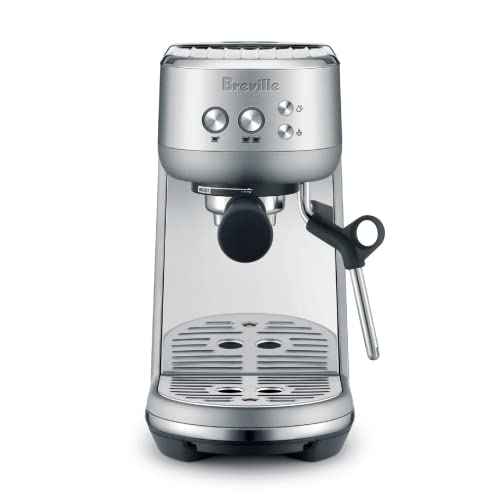
6. Breville BES450BSS Bambino Espresso Machine — Best for heavy use
A claimed 3-second heat-up and an automatic steam wand, in a 10.9 lb body that still fits a normal counter.
Best for: several cups a day with no waiting between them Skip it if: 10.9 lb is more than you want to move
Breville's ThermoJet system is claimed to reach extraction temperature in 3 seconds. Compare that to the CASABREWS instruction to let the machine cool between frothing and brewing, and you can see where the Bambino earns its keep: back-to-back cups without a waiting period.
The automatic steam wand is the other reason it sits this high. Breville says it lets you set milk temperature and texture rather than judging both by hand, which removes the single fiddliest step in making a latte. Digital temperature regulation and low-pressure pre-infusion are both listed, and the warranty is one year from the manufacturer.
At 10.9 lb it is the second-heaviest pick here, and its 12.2 x 12.6 in footprint needs genuine counter depth. That is the cost of the faster heater and the automatic wand.
Against the Barista Express below it, the Bambino gives up the integrated grinder and gains half the weight. Against the CM5418 above it, it costs considerably more and asks you to lift another two pounds. Which way that falls depends entirely on how many cups a day you make.
Pros:
- 3-second heat-up claimed by Breville
- Automatic steam wand sets temperature and texture
- Digital temperature regulation listed
- 1-year manufacturer warranty
- Half the weight of the Barista Express
Cons:
- Second-heaviest pick at 10.9 lb
- No grinder, unlike the Barista Express
- 12.6 in depth needs a full-depth counter
- Premium price position without a grinder
7. Breville BES870XL Barista Express Espresso Machine — Best premium
The only machine here with a built-in conical burr grinder, and at 22.1 lb the only one that has to stay put.

Best for: a permanent counter spot and whole-bean coffee Skip it if: the machine has to be lifted or stored between uses
One feature justifies the price and the bulk: an integrated precision conical burr grinder that Breville says grinds on demand straight into the portafilter. That deletes a second appliance from the counter, and it deletes the step of scooping ground coffee from a bag into a basket, which is finicky work.
The extraction hardware is the most complete in the set. Low-pressure pre-infusion, digital temperature regulation via PID, and a manual steam wand for microfoam. Breville also includes two bags of specialty coffee on registration, with terms applying. Warranty is one year limited.
Then the numbers. It weighs 22.1 lb, which is more than double the winner, and measures 15.9 x 13.8 x 12.5 in. This is a machine you install, not one you put away. Two sellers list it, the most of any pick here.
The judgment is simple. If the machine gets a permanent home at a comfortable working height, the grinder alone may make this the easiest of the seven to use daily. If it needs to move, 22.1 lb rules it out immediately.
Pros:
- Only pick with an integrated conical burr grinder
- PID digital temperature regulation
- Low-pressure pre-infusion for even extraction
- Two bags of coffee on registration, terms apply
- Listed by more sellers than any other pick
Cons:
- 22.1 lb, by far the heaviest here
- 15.9 in wide, the largest footprint in the set
- Highest price position of the seven
- Grinder adds a cleaning task the others do not have
What does the extra money actually buy here?
Across these seven, the money buys three things and it does not buy a fourth.
At the entry positions, the CASABREWS 3700, the AERCANA and the atatix, you get a 20-bar pump, a steam wand and a stainless body. Weights start at 7.5 lb. The AERCANA even throws in the longest warranty figure and the only pressure gauge, which shows that price position and useful features do not always move together.
In the middle, the CM5418 adds a written 1-year warranty over its cheaper sibling and the strongest sales position in this set. That is reassurance rather than hardware.
At the premium positions, the De'Longhi, the Bambino and the Barista Express, you buy automation. Two-setting wand, customizable presets, 3-second heat-up, PID temperature control, pre-infusion, and in one case a burr grinder.
What extra money does not buy is lightness. It buys the opposite. The most expensive pick here weighs 22.1 lb against the cheapest tier's 7.5 lb. If handling is your constraint, spending more works against you unless you are specifically buying the automation, and you should know which feature you are paying for before you commit.
Which best espresso machine for seniors suits which kitchen?
Run these five checks in order and the choice usually makes itself.
- Will the machine be lifted or stored? If yes, cap yourself at 9 lb and the Barista Express and Bambino are out.
- How deep is the counter? Anything under 13 in of usable depth rules out the Bambino at 12.6 in and the Barista Express at 13.8 in.
- Is there a wall cabinet above? The De'Longhi stands 8.89 in tall and the Barista Express 12.5 in, so measure the gap.
- Do you grind your own beans? If yes and there is counter space, the Barista Express saves you an appliance.
- Does a written warranty matter? Five of seven publish one. The CASABREWS 3700 and the De'Longhi do not.
Two specific flips worth naming. If you make one cup a day, the fast heat-up of the Bambino is spending you will not feel, and the CM5418 does the same job at 8.59 lb. But if two people each want two cups every morning, the cooling delay CASABREWS warns about becomes the daily annoyance, and the Bambino's 3 seconds is the answer.
The other flip is milk. If milk drinks are most of what you make, the De'Longhi's 2-setting wand or the Bambino's automatic one both replace a hand skill with a control, and either beats the winner on that one job.
The verdict
The CASABREWS CM5418 is the best espresso machine for seniors in this set, because it hits the only specification that gates everything else. At 8.59 lb it moves easily, it publishes a 1-year warranty when the cheaper CASABREWS does not, and it is the machine buyers here choose most often. Nothing lighter matches that combination of weight, warranty and track record.
Two conditions flip it.
If the machine gets a permanent counter spot at a comfortable height, take the Breville BES870XL Barista Express. Its exact advantage is the integrated conical burr grinder, which means no separate grinder, no scooping and no bag of stale pre-ground coffee. The cost is 22.1 lb and a 15.9 in width, and neither matters if the machine never moves.
If most of what you make is milk drinks, take the De'Longhi Classic Signature. Its 2-setting adjustable wand turns milk texturing from a judgment call into a switch, and at 9 lb it barely costs you anything in handling. The catch is no published warranty, so weigh that.
The atatix deserves a mention as the lightest here at 7.5 lb with a 1-year warranty behind it. It loses the top spot on footprint depth, not on quality.
FAQ
Is an espresso machine worth it for seniors compared with drip coffee?
An espresso machine is worth it if you actually prefer espresso-based drinks, and not otherwise. Every pick here needs you to fill a tank, dose grounds, lock a portafilter and clean it afterwards. A drip machine skips most of that. Buy espresso for the drink quality and the milk texturing, not to save effort.
What is the best espresso machine for seniors on a tight budget?
The best espresso machine for seniors at the lowest price position here is the CASABREWS 3700 Essential. It weighs 8.14 lb, lighter than the overall winner, and its listing claims the same 20-bar pump and 1350 W heating system. The compromise is real though: no warranty is published, and it sells more slowly than the CM5418 that does state one.
CASABREWS CM5418 or Breville Bambino: which should I choose?
Choose between the CM5418 and the Bambino on cups per day. The CM5418 weighs 8.59 lb and CASABREWS warns you to let it cool between frothing and brewing. The Bambino weighs 10.9 lb and claims a 3-second heat-up with an automatic steam wand. One cup a day, take the lighter machine. Four cups, take the faster one.
Does bar pressure or warranty length tell me more about quality?
Bar pressure and warranty length answer different questions, and pressure is the weaker signal. Five of these seven claim 20 bar, so it barely separates them, and espresso extracts near 9 bar anyway. Warranty length is more useful here: the AERCANA lists 2 years, four picks list 1 year, and two publish nothing at all.
What mistake do first-time espresso buyers make most often?
The mistake first-time espresso buyers make most often is measuring the machine's width and forgetting depth and height. The Barista Express is 13.8 in deep and the Bambino 12.6 in, and a rear water tank needs clearance behind that to lift out. Measure all three dimensions, plus the gap under any wall cabinet, before you order.
Start with the space, not the specification list. Measure your counter depth and the clearance above it, then decide whether the machine stays put or gets stored, and the seven picks here sort themselves into two short lists in about a minute. For most kitchens where the espresso maker has to move, the CASABREWS CM5418 is the sensible default, because 8.59 lb with a written 1-year warranty is a combination nothing else here matches. If the counter has room to spare, spend the difference on the Barista Express and let its grinder take one more fiddly job off your hands.